
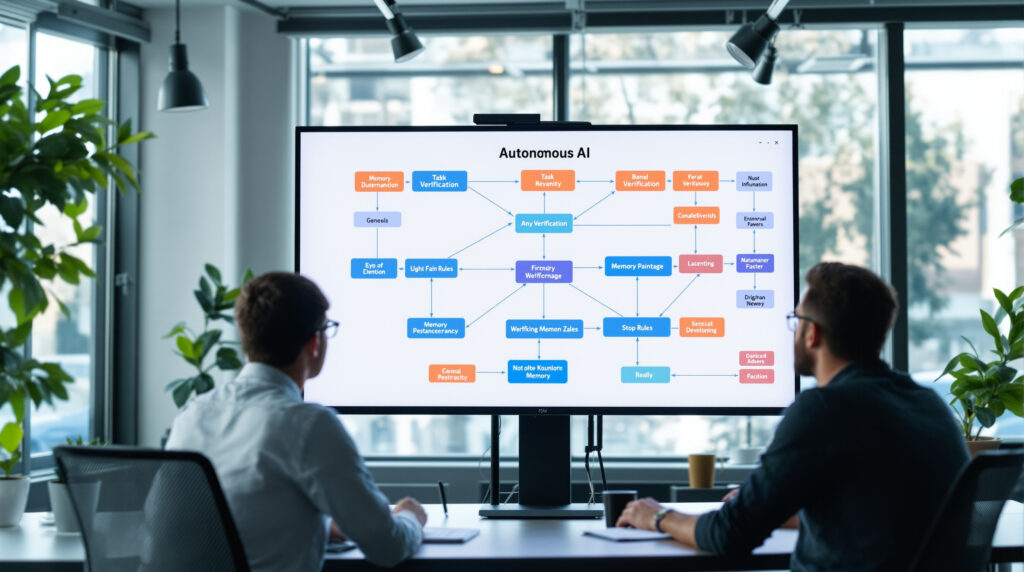
Loop engineering consists of designing an autonomous work loop for an AI agent: it detects a task, acts, checks, memororizes the state, then starts again or stops. For a business leader, the issue is not the buzzword. It is the ability to automate certain development, support, or analysis tasks with less micromanagement, but also with new risks related to cost, quality, and security.
Loop engineering: what are we really talking about?
The term loop engineering became popular in June 2026, notably through statements attributed to Addy Osmani, an engineer at Google, with cited influences such as Peter Steinberger and Boris Cherny at Anthropic. Primary sources that use the exact expression remain rare. At this stage, it is therefore more a way of naming an emerging practice than an official norme.
The idea is simple: instead of writing a detailed prompt at each step, you design a loop. This loop gives the AI agent a goal, tools, verification rules, external memory, and stopping conditions. It can, for example, open a GitHub task, modify code in an isolated space, run tests, request a review, then start again if the result fails.
Loop engineering can be seen as a layer above prompt engineering (the art of formulating a request), context engineering (managing useful information), and agent tooling (connectors, scripts, and environments). The difference lies in controlled repetition. A good loop does not just produce; it observes what it has produced.
What this changes for a web or mobile project
For an SME, the topic becomes concrete as soon as a project contains repetitive tasks: bug fixes, test generation, content migration, page auditing, technical documentation, pull request reviews (proposed code changes). The agent does not replace business scoping. It can, however, reduce time wasted on well-borned tasks.
In the projects we lead, we often see the same limitation: AI greatly speeds up the first version, then problems appear when no one has defined how to verify, stop, or resume the work. Loop engineering responds precisely to this weakness. It transforms a series of improvised attempts into a monitored process.
The tools cited in discussions in 2026 point in this direction. Anthropic documents Claude Code with command-line uses, slash commands, GitHub Actions integration, and MCP connectors (a protocol for connecting to external tools). OpenAI describes Codex as a cloud software agent connected to GitHub, with parallel tasks, isolated sandboxes, worktrees, automations, skills, and memories. These building blocks do not always officially bear the name loop engineering, but they make it possible to build its mechanisms.
If your project already relies on a modern architecture, for example a SaaS application in Next.js, Supabase and Stripe, these loops can help maintain velocity. But they require a solid foundation: a clean Git repository, automated tests, separate environments, limited access rights. Without that, the agent works quickly in a fog. A bad combination.
The components of a useful AI loop
The explainers published in June 2026 converge on a few building blocks: automations, isolated spaces, reusable procedures, connectors, evaluation sub-agents, and external memory. In other words, you are not just creating an instruction. You are creating a small production system.
- A trigger : a scheduled task, a GitHub ticket, a quality alert, a support request.
- An isolated space : sandbox or Git worktree, to prevent the agent from modifying the main version directly.
- Skills : reusable procedures, such as “corriger a broken test” or “document an API”.
- Tools : GitHub, integrated browser, database, MCP, test scripts, security scanners.
- An evaluator : automated tests, review agent, human review, or a tool like CodeRabbit depending on the case.
- Stopping rules : maximum budget, number of failures, sensitive permission, need for human arbitration.
The last point is often underestimated. A loop without a stopping rule can consume tokens, open too many branches, attempt contradictory corrections, or hide a real product decision behind artificial activity. With this budget, a short, observable, and limited loop is better than an “autonomous” agent running without clear supervision.
Realistic budgets, timelines, and trade-offs
Loop engineering is not free, even if AI tools create an impression of magic. You have to account for design time, integration with existing tools, testing, security, and maintenance. In France, depending on the complexity and the expected level of governance, a first professional loop often costs from a few thousand euros to several tens of thousands of euros.
| Use cases | Estimated timeline | France market budget | Main risk |
|---|---|---|---|
| Automatic review of pull requests with simple rules | 1 to 2 weeks | 3,000 to 8,000 € | False sense of security |
| Supervised bug correction with automated tests | 2 to 5 weeks | 8,000 to 25,000 € | Loop that corriges a symptom without addressing the cause |
| Content migration or technical SEO agent | 3 to 6 weeks | 10,000 to 35,000 € | Data corruption or pages published too quickly |
| Governed agentic runtime for product team | 6 to 12 weeks | €30,000 to €90,000 and more | Operational complexity and unclear responsibilities |
These ranges do not replace an estimate. They provide an order of magnitude. A loop connected to GitHub Actions, Cloudflare, OVHcloud, or a Kubernetes environment does not require the same effort as a simple internal assistant run on demand.
The right trade-off depends on how often the task occurs. Automating an operation performed twice a year is rarely justified. On the other hand, a daily code review, a repeated test suite, or an SEO analysis across hundreds of pages can quickly pay back the investment. For visibility-related topics, the logic also aligns with the methods of AI-assisted internal linking : automation is useful if the editorial rules remain explicit.
The trap: confusing autonomy with lack of control
The obvious solution, letting the agent decide on its own until it gets a result, is often the wrong one. An AI agent does not have your legal responsibility, your business understanding, or your tolerance for risk. It can produce code that works locally but introduces a vulnerability, an unnecessary dependency, or a subtle regression.
The practical guides published in 2026 emphasize stopping rules: cost cap, token limit, repeated failures, change in permissions, step requiring a human. That is healthy. As soon as a loop touches personal data, payment, authentication, or production, the GDPR of 2016 and traceability requirements must come back to the forefront.
The security of AI-generated code deserves special attention. A loop can repeat a bad assumption faster than a human, especially if the evaluator only tests that “it works.” Before deploying this type of workflow, it is better to plan dedicated controls, like those described for the security of code produced with AI.
Honestly, this approach is only justified if you are willing to formalize your rules. If your team has neither tests, nor a clear definition of “done,” nor separation between development and production, start with those foundations. Loop engineering will come afterward.
When to adopt it, and when to wait
The right time comes when your organization already has repeatable and measurable digital tasks. A clean backlog, well-written tickets, a version-controlled codebase, and a few automated tests are sometimes enough to get started. There is no need for a perfect software factory.
Conversely, it is better to wait if business needs change every week or if trade-offs remain highly political: product priorities, editorial tone, acceptable level of risk, architecture choices. In these cases, AI can prepare, compare, and document. It must not decide on its own.
From an agency perspective, the reflex is to start with a narrow loop: one task, one repository, one isolated environment, one success metric. For example, generate missing tests on a specific module, then have each proposal reviewed by a developer. It is less spectacular, but much more reliable than a large cross-functional agent connected everywhere from the very first month.
The subject aligns withagentic engineering applied to development : the challenge is not to produce more code, but to create a system capable of moving forward with guardrails. The teams that save time are rarely the ones that “prompt” the most. They are the ones that know what to delegate, what to verify, and when to take back control.
Defining this type of project upstream avoids most unpleasant surprises: hidden costs, overly broad access, quality that is difficult to prove, unclear responsibilities. An outside perspective is especially helpful in transforming an appealing idea into a limited, testable loop that can be used over the long term.
FAQ on loop engineering
What is the difference between prompt engineering and loop engineering?
Prompt engineering consists of properly formulating a request to AI. Loop engineering designs the complete cycle: task, action, verification, memory, repetition, and stop.
Is loop engineering already an official technology?
Not really. In 2026, the expression is mainly used in explainers, blogs, and technical discussions, while products like Claude Code or Codex tend instead to document the necessary building blocks.
Can an SME use loop engineering without an AI team?
Yes, if the scope remains limited and the existing tools are clean: GitHub, tests, separate environments, controlled permissions. Without these basics, the risk quickly outweighs the benefit.
Which projects are best suited to AI loops?
Repetitive and verifiable tasks: code review, test generation, documentation, content migration, technical audit. Sensitive business decisions must remain supervised by humans.