
Muse Image is Meta’s new image generator, announced on July 7, 2026 and integrated into Meta AI, Instagram, and WhatsApp. For an SMB, the challenge is simple: produce social visuals faster, test creative ideas, and edit images without going through several tools. However, the rollout remains limited, notably with no specific date for France.
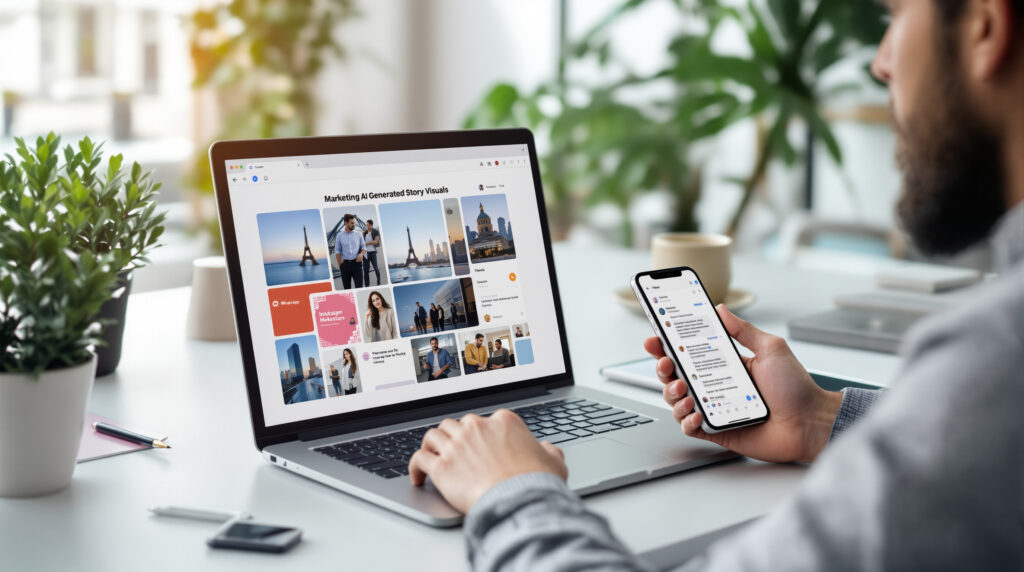
Muse Image: what Meta actually announced
Muse Image is presented by Meta as its first image generation model from Meta Superintelligence Labs. Here, a model refers to the artificial intelligence system trained to create or modify visuals from instructions.
Since its launch on July 7, 2026, Muse Image has been available in Meta AI for image generation and editing. It also powers more than 30 new AI effects in Instagram Stories and allows image generation in direct conversations with Meta AI on WhatsApp, initially in a limited number of countries.
The key takeaway is not just the model’s supposed quality. It’s where it is located. Meta is not launching a standalone tool like Midjourney or Adobe Firefly: it is inserting it directly into the everyday uses of Instagram, WhatsApp, then Facebook and Messenger. For a brand, this reduces the distance between the idea, creation, and publication.
According to Blog du Modérateur, the rollout mainly concerns the United States at this stage, with no precise timeline announced for France as of July 8, 2026. So, if your marketing team does not yet see these features in its accounts, it is not necessarily a configuration issue.
What Muse Image can do in Instagram and WhatsApp
Meta indicates that Muse Image can generate an image from a prompt, that is, a text instruction, or from an existing photo. It can also blend several photos, erase objects, produce readable text in the image, and create QR codes.
These capabilities change several very concrete tasks. A store can test a campaign visual before booking a shoot. A restaurateur can adapt a menu visual for a Story. An association can prepare a visual with a QR code to a registration page, then adapt it for WhatsApp.
Meta also mentions presets, in other words preconfigured styles, the possibility of mentioning Instagram accounts with @ to incorporer public photos, and direct annotation on the image to guide modifications. This last point is practical: instead of writing “move the product to the left,” you can draw or indicate the area to corrige.
Be careful of the subtle trap. Being able to integrate public photos via Instagram accounts does not mean that all commercial uses will be risk-free. Image rights, trademark rights, model releases, compliance with the GDPR 2016/679 for personal data: technical ease does not remove the legal framework.
Impact on budget, timelines, and marketing organization
For a business owner, Muse Image raises a very pragmatic question: how much time and money can actually be saved? On simple social media visuals, the gain can be clear. A format variation, a background to replace, a seasonal Story: these are tasks that sometimes took half a day between briefing, execution, and approval.
In the French market, a pack of social media visuals produced by a freelancer or a studio often starts at around €300 to €800 depending on volume, retouching, and art direction. A day of art direction or graphic design can easily range between €400 and €900 before tax. Muse Image does not replace all of that value, but it can reduce the number of back-and-forth exchanges on low-stakes visuals.
Meta announces that everyday creation with Muse Image is free, while heavier use is included in Meta subscriptions. Pricing details will therefore depend on the available plans and countries. At that budget, it is better to avoid building an entire marketing process around a feature still in limited rollout.
On the projects we lead, we often see a good hybrid approach: AI is used to explorer 10 directions quickly, then a human locks in the sensitive elements, such as brand consistency, tone, legal notices, and ad formats. It is less spectacular. It is more reliable.
| SMB use | Without generative AI | With Muse Image or equivalent | Point of vigilance |
|---|---|---|---|
| Promotional Instagram Story | 2 to 5 days with briefing, creation, feedback | A few hours to produce variants | Compliance with graphic guidelines |
| Simple retouching of a product visual | €80 to €250 depending on provider | Low marginal cost if the tool is included | Final quality before publication |
| Meta Ads advertising campaign | €500 to €2,000+ depending on the number of concepts | More creative tests via Advantage+ creative | Legal validation and message consistency |
| Strategic brand visual | Dedicated art direction, variable budget | AI useful for mood boards, rarely sufficient on its own | Differentiation and usage rights |
Meta advertising: why Advantage+ creative matters
Meta indicated that advertisers and agencies will access Muse Image via Advantage+ creative “in the coming weeks.” Advantage+ creative refers to Meta Ads’ creative automation features, capable of adapting advertising content according to audiences, placements, and performances.
In concrete terms, this can help produce more variants: backgrounds, formats, visual hooks, product staging. For an SMB investing a few hundred or a few thousand euros per month in advertising, the difference can come from testing speed. Three creative ideas tested are often better than a single visual approved too late.
But the obvious solution can be the wrong one. If your brand sells consulting, medical, finance, or a premium service, generating too many artificial visuals can weaken trust. Honestly, this technology is only justified if it speeds up measurable tests or repetitive production, not if it dilutes your positioning.
To place these uses back into a broader strategy, the reflections on the use of artificial intelligence by web agencies help distinguish useful automation from an expensive gadget. The same logic applies to acquisition: a high-performance ad creative does not make up for a slow, unclear page or one that is poorly tracked in Analytics.
Quality, invisible watermark, and competition with other AI
Axios reports that Meta claims Muse Image generally outperforms Google Nano Banana 2 on several benchmarks, while still remaining behind ChatGPT’s image generator. A benchmark is a standardized comparative test. Take this with caution: these evaluations say something about average quality, not necessarily about your specific use case.
TechCrunch indicated that Muse Image was internally codenamed “Mango.” The Next Web, for its part, reported that all images generated with Muse Image include an invisible watermark, a digital marker intended to signal the file’s AI origin without being visible to the naked eye.
This watermark is rather beneficial for businesses. It makes traceability easier, especially when several people produce visuals from different accounts. It does not solve everything: a file can be cropped, compressed, re-exported, or integrated into another composition. So keep an internal archive of prompts, sources, and approvals.
Blog du Modérateur also reports that Muse Image replaces third-party technologies that Meta previously used for visual creation, including Midjourney. It is an important signal: Meta wants to control its AI chain, from models to distribution surfaces. For brands, this probably means more integration, but also greater dependence on the Meta ecosystem.
How to use it without weakening your brand
The right way to use Muse Image starts before the prompt. An SMB must first decide what can be automated and what deserves controlled creation. A temporary Story visual does not carry the same level of risk as a national campaign visual or an image integrated into your showcase website.
A simple method is to classify your content by level of importance. Low importance: social variants, backgrounds, internal illustrations. Medium importance: Meta ads, newsletters, article visuals. High importance: visual identity, sales pages, contractual product visuals, regulated content.
- Define a prompt charter: tone, colors, prohibitions, formats, brand mentions.
- Keep human validation before any paid or commercial publication.
- Avoid using real faces, third-party logos, or public photos without checking the rights.
- Test visuals on mobile, because Instagram and WhatsApp are primarily viewed on small screens.
- Archive the selected versions with date, objective, channel, and person responsible.
On the agency side, the instinct is to connect these creations to simple indicators: click-through rate, cost per result, conversion on the landing page, brand recall when it is measurable. Without that, production volume is confused with actual performance.
Stock image libraries do not disappear for all that. For neutral, documentary, or very realistic visuals, royalty-free stock image libraries are sometimes faster and less risky. When it comes to SEO, this topic also ties into the issue of AI-assisted SEO : the tool helps, but editorial strategy and proof of expertise make the difference.
Availability in France and decisions to make now
As of July 8, 2026, no precise French launch date has been publicly announced according to the available information. FoneArena reminds us that the new Instagram Stories experience is currently available only in the United States, while WhatsApp is starting in limited countries.
Should you wait before organizing? Not entirely. You can already clarify your internal rules for using visual AI, trorin your teams in prompting, and compare Muse Image with existing solutions like Adobe Firefly, Canva, Midjourney, or ChatGPT’s image generator depending on your needs.
If your company is planning to develop a mobile app, a customer portal, or a business tool with AI capabilities, the issue goes beyond Instagram. The same trade-offs arise: privacy, API costs, hosting, traceability, and user experience. Useful insights can be found in this analysis of use cases for an AI mobile app for SMEs and in the best practices of mobile privacy by design.
Defining this type of project upstream avoids most unpleasant surprises: dependence on a platform, poorly understood usage rights, content that is impossible to maintain. This is often where an outside perspective saves time, especially when creation, advertising, website, and customer data intersect.
FAQ about Muse Image
Is Muse Image available in France?
As of July 8, 2026, Meta has not given a specific date for France. The initial rollouts mainly concern the United States and a limited number of countries for WhatsApp.
Is Muse Image free?
Meta states that daily creation with Muse Image is free. Higher usage levels are included in Meta subscriptions, the details of which may vary by country and offer.
Can Muse Image be used for Meta Ads advertisements?
Yes, Meta announced an arrival in Advantage+ creative for advertisers and agencies in the coming weeks following the launch. Human validation remains recommended before commercial distribution.
Are images generated by Muse Image identifiable?
According to The Next Web, images created with Muse Image include an invisible watermark. It is used to trace AI origin, even if an internal archive remains preferable for professional use.