
AI Overviews links are becoming more numerous and appearing higher in Google-generated answers as of October 15, 2026. Google is also testing a block highlighting one or two official pages. These changes may improve publishers’ and brands’ visibility, but no traffic gain had been demonstrated as of October 21, 2026.
What is changing for AI Overviews links?
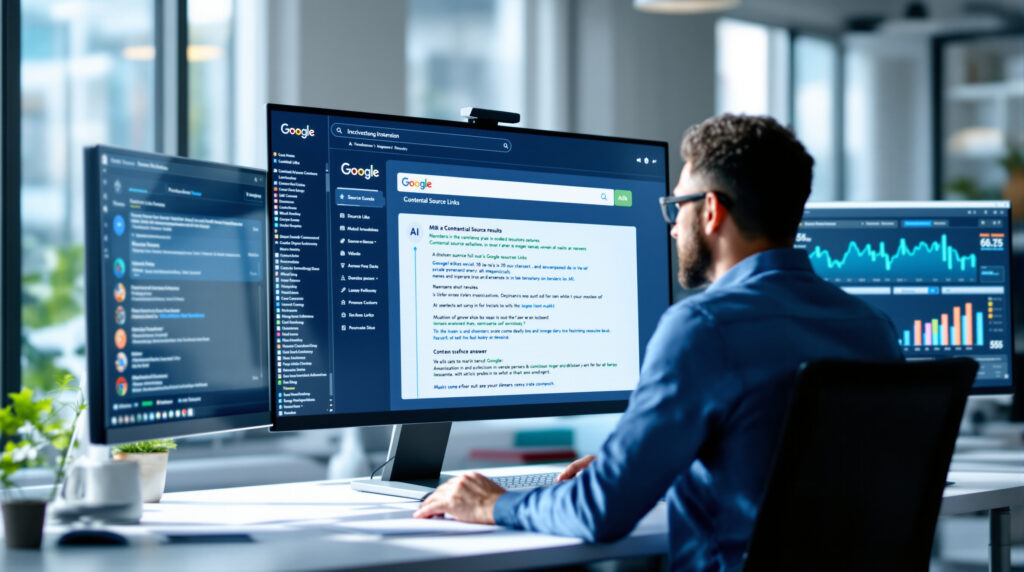
Since October 15, 2026, Google has been displaying more contextual links directly in AI Overviews and AI Mode, positioning them higher in responses. The stated goal is to make it easier to access pages that provide more detail about information, without requiring users to search for sources at the bottom of the generated content.
AI Overviews is a Google Search feature that synthesizes multiple pieces of information above or in the middle of the standard results. AI Mode offers a more conversational search experience in which users can ask follow-up questions.
The change primarily concerns links integrated into the response’s sentences. They are becoming more visible and more frequent. Google also announced more visual “Dive Deeper” links, as well as clickable publisher or creator names in some video results, according to Search Engine Land on October 15, 2026.
Another development concerns carousels of recent articles. Google has been expanding them to more languages and geographic areas since October 15, 2026. These spaces may feature publications selected by a user in Preferred Sources, the feature that allows users to prioritize certain news sources.
The detail matters: the increase in embedded links and the expansion of carousels are being presented as rollouts. The block reserved for official sites, however, remains a test. A company should therefore not build its traffic forecasts as if all these interfaces were already widely available.
Will Google finally send more traffic to websites?
As of October 21, 2026, no reliable data had shown that the new AI Overviews links increased publisher traffic. The rollout had begun six days earlier. Greater visibility may encourage clicks, but a link’s position guarantees neither additional visits, nor leads, nor revenue.
Available studies mainly describe the earlier situation. A study published on arXiv in August 2026, based on one month of browsing by 900 American adults, observed a click on a cited source in approximately 1% of visits containing an AI Overview. This measurement predates the new October 2026 interface and therefore cannot be used to assess its effect.
Another preregistered field experiment, published on arXiv in August 2026 among 1,100 participants, found that removing AI Overviews and AI Mode increased the click-through rate to publishers. Here again, the experiment predates the repositioning of the links.
These findings explain why the decline in media traffic associated with AI Overviews remains an issue to monitor. They do not mean that all sites will experience the same decline. A query asking for a simple definition may be answered within Google, whereas a comparison of providers, a download, or a quote request is more likely to prompt a visit to the source page.
In the projects we work on, we often see a misinterpretation: an increase in impressions is taken to mean an increase in demand. Yet a citation in a generated response can increase awareness without immediately producing a click. Visibility, traffic, and business results must be separated.
Which sites can benefit from the official sources block?
Since October 15, 2026, Google has been testing an area placed at the top of certain responses, with one or two official or particularly relevant pages. Each link may be accompanied by context explaining its usefulness. This format is primarily intended for precise tasks and searches requiring exact information from the original source.
An official page could be, for example, a publisher’s documentation, a service’s pricing page, or a procedure published by the responsible organization. For an SMB, the issue therefore extends beyond the blog: product pages, help content, terms of use, and institutional pages must provide a clear and verifiable answer.
Le piège méconnu consiste à concentrer tout le contenu utile dans un PDF, une image ou une interface accessible après connexion. Google doit pouvoir explorer et indexer la page, c’est-à-dire la lire puis l’enregistrer dans son moteur. Une version HTML claire offre généralement un accès plus direct aux informations importantes.
Identity consistency also matters. The company name, its offerings, its authors, and its contact information should remain consistent from one page to another. Work on the association between a brand and its areas of expertise helps search engines understand who publishes the information and in what capacity.
Honestly, creating dozens of nearly identical pages to target every formulation would be a poor response. It is better to have one complete, up-to-date official page structured around the user’s actual task.
Should you change your SEO strategy for AI Overviews?
In 2026, Google stated that no additional technical requirements are necessary to appear in AI Overviews or AI Mode. Standard SEO practices still apply: the page must be indexed and eligible for a snippet in Google Search. A redesign dedicated solely to the new interface is therefore not justified.
Visit referencing naturel, ou SEO, regroupe les méthodes qui rendent un site compréhensible, accessible et pertinent pour un moteur de recherche. Les bases restent la qualité éditoriale, l’architecture des pages, les liens internes, la performance technique et des informations attribuables. Le way search engine optimization works therefore remains the foundation, even when the response takes a generative form.
In 2026, Google recommends measuring visibility in AI-assisted search and the downstream results obtained, rather than adopting special tactics simply because an interface has changed. A useful page should answer quickly, identify its sources, and make the next step obvious.
Here are the reasonable actions to prioritize before undertaking a redesign:
- check in Google Search Console that strategic pages are indexed and receiving impressions;
- place a self-contained answer at the beginning of each important section;
- update dates, authors, prices, and terms as soon as they change;
- make official pages accessible in HTML, without relying solely on a downloadable document;
- track conversions from Google, not just rankings or session volume;
- strengthen internal links between guides, offers, studies, and reference pages.
From an agency perspective, the instinct is to preserve what is already working above all else. At this stage, it is better to allocate the budget to the quality of important pages and measurement than to an “AI optimization” layer isolated from SEO. The methods that make it possible tobe cited in Google and generative assistants should remain connected to the site’s business objectives.
How can you measure the effect of the new AI Overviews links?
Measurement should compare a period before October 15, 2026, with several subsequent weeks, separating visibility, clicks, and conversions. Google Search Console provides impressions and clicks from Google Search, while an analytics tool measures qualified visits, forms, sales, or calls generated.
A single week would be too sensitive to promotions, seasonality, or current events. For an SMB with moderate traffic, a four- to eight-week window in 2026 provides a more useful view, provided it is compared with a similar period. This duration is an observation method, not a statistical guarantee.
| Indicator | Tool or source | What it helps you understand | Main boundary |
|---|---|---|---|
| Google impressions | Google Search Console | Changes in page visibility | An impression does not prove that an AI Overviews link was seen |
| Clicks and click-through rate | Google Search Console | The result’s ability to generate a visit | Seasonality can distort a short comparison |
| Organic sessions | Analytics tool | Volume of visits from search engines | GDPR consent may reduce measurement |
| Conversions | Analytics, CRM, or call tracking | Business impact of visits acquired | A low volume requires a longer period |
| Brand citations | Manual review or tracking tool | Brand presence in generated responses | Responses vary depending on the query and context |
Create a baseline by page group: editorial content, product pages, documentation, and brand pages. Then compare informational queries with commercial queries. This segmentation prevents a decline in low-value definition searches from masking an increase in qualified inquiries.
Ne modifiez pas simultanément les titres, le contenu, le internal networking et le suivi analytique. Comment attribuer ensuite une variation aux liens AI Overviews ? Procédez par lots limités et consignez chaque date de changement.
What trade-offs should be planned for the budget and timeline?
The changes announced by Google on October 15, 2026, do not, by themselves, justify a redesign budget. A small or medium-sized business should first fund an assessment, correct the strategic pages, and make measurement reliable. The timeline depends primarily on the number of content items, technical constraints, and the available conversion volume.
A targeted review can focus on indexing, the answers appearing at the top of pages, the sources of information, and goal tracking. A site with a few dozen pages can be handled faster than a catalog containing thousands of items. The real cost often comes from updating the editorial content, not from a hidden setting specific to AI Overviews.
The right trade-off is to prioritize pages that support a decision: comparison, price, compatibility, availability, procedure, or proof of expertise. To prepare for the medium term without following every passing trend, the SEO and GEO criteria to prioritize for 2027 provide a more sustainable framework.
Defining the measurement approach and priority pages in advance avoids most defensive spending. This is often where an outside perspective helps distinguish an interface change from a structural content, technical, or conversion problem.
FAQ about links and visibility in Google AI
How can I appear as a source in Google AI Overviews?
A page must be indexed by Google and eligible for a search snippet. Google stated in 2026 that no special markup or dedicated file is required to appear in AI Overviews.
Does Google Search Console distinguish clicks originating from AI Overviews?
Google Search Console incorporates activity from artificial intelligence features into Google Search, but it does not necessarily provide a standalone report that isolates every click originating from an AI Overview. Analysis by page, query, and period remains necessary.
Does Preferred Sources guarantee that a publisher will appear on Google?
Preferred Sources allows users to prioritize certain publications in news spaces, but it does not guarantee an appearance for every query. Google expanded the associated carousels to more regions and languages on October 15, 2026.
Does being cited in an AI response improve SEO?
A citation in a generated response may increase a brand’s exposure, but no automatic effect on rankings or traffic is guaranteed. Citations, clicks, and conversions should be tracked as three separate outcomes.