
Local SEO for Google Business Profile involves making your listing accurate, reliable, and active enough to appear in Google Search, Google Maps, and “near me” searches. In 2026, Google continues to emphasize three main criteria: relevance, distance, and notority. For your project, this mainly affects the budget: it’s better to invest in a well-maintained listing, genuine reviews, and strong local pages than in short-term tricks.
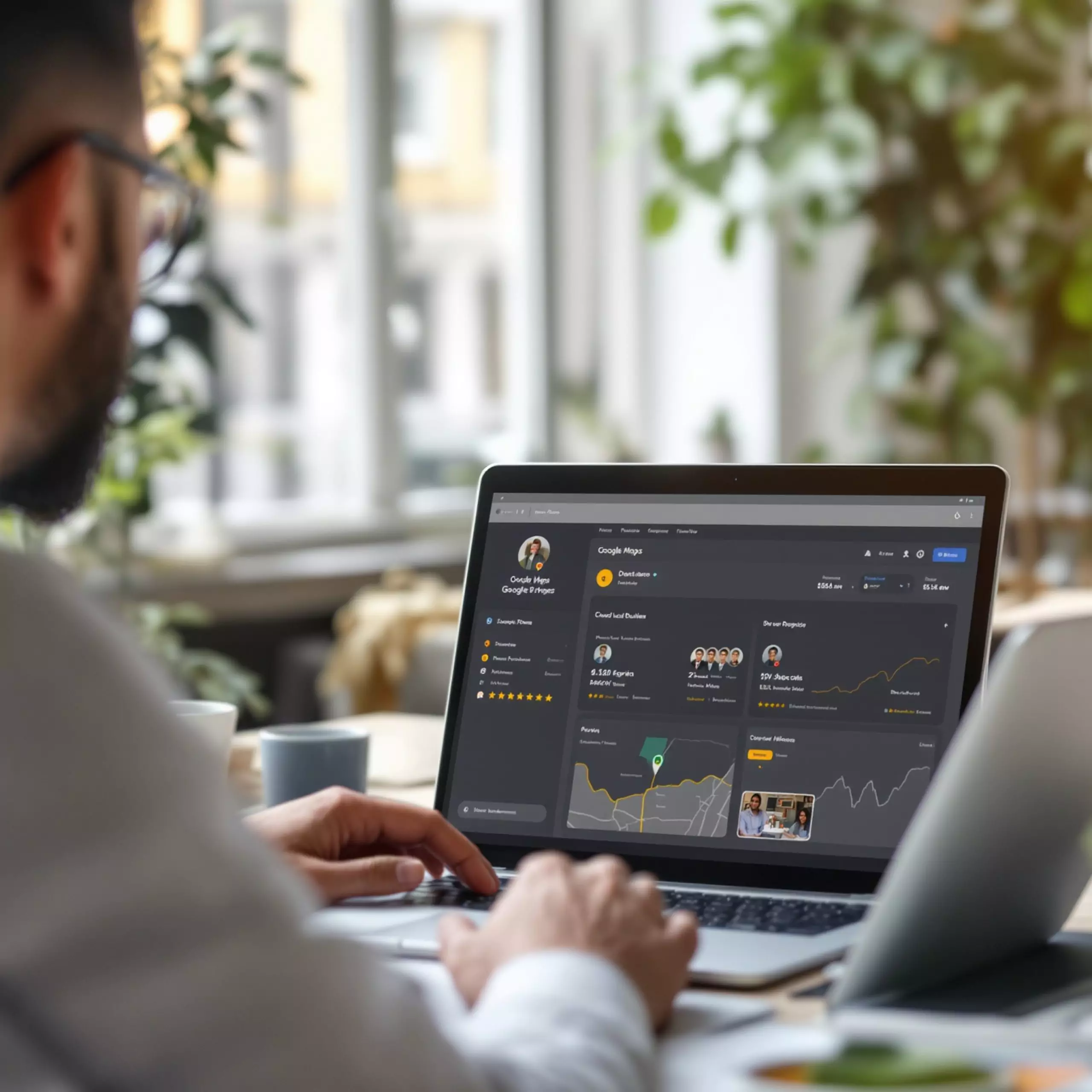
Local SEO for Google Business Profile: What Google Really Looks For
Google Business Profile, formerly Google My Business, is the listing that displays your business on Google Maps and in the local section of search results. It’s free, but optimizing it requires time, a systematic approach, and strict consistency with your website.
Google states that, as of 2026, local rankings are based primarily on three factors: relevance—that is, how well your listing matches the search query; distance, meaning proximity to the user or the searched-for area; and notorié, which reflects your business’s perceived popularity both online and hors.
The classic temptation is to look for “the magic formula”: posting every day, adding a hundred photos, accumulating keywords in the name. That’s a bad habit. Google does not publish any reliable numerical weights for reviews, photos, posts, or NAP consistency in 2026. The real work, therefore, is to reduce ambiguities and prove that your business does indeed match a local search intent.
In practical terms, a plumber in Montreuil, a dental office in Paris’s 15th arrondissement, and a bike shop in Lyon face different challenges. The first relies on urgent “near me” searches, the second on a high level of trust, and the third on information about inventory, prices, and directions. Same tool, different priorities.
How can you optimize your Google Business Profile listing?
A high-performing listing starts with accurate information. Actual business name, address, phone number, website, hours of operation, primary category, services, attributes, service area: every field that’s filled out incorrectly creates doubt. And doubt costs you calls.
Google also specifies the eligibility requirements: the business must serve customers at a physical location or visit their homes as part of a service area model. A virtual address, an unoccupied shared office, or a listing created to cover a city without a physical presence may result in changes, restrictions, or removal.
The trap that many business owners fall into: changing the page title to slip in keywords may work for a few weeks, but it can then expose the page to suspension or penalties from Google. Given this time frame, it’s better to focus on the site’s category, services, and local pages. For a tradesperson, for example, the useful pages described in a a showcase website designed to generate local inquiries It helps you understand the activity without misrepresenting its name.
Photos and videos also help overcome barriers. Storefront, staff, projects, waiting room, service vehicles, products, and accessible entry: these are concrete examples. A blurry photo from 2019 rarely inspires confidence, even though Google doesn’t say that a recent photo provides a measurable ranking boost.
- Verify that the name, address, and phone number are consistent across the business listing, the website, reputable directories, and social media platforms.
- Select a specific primary category, and then select secondary categories only if they correspond to actual services.
- Describe services using terms that a customer can understand, not just a subject-matter expert.
- Add recent, representative photos—no generic stock images.
- Update the special Hor schedules before holidays, vacation periods, and temporary closures.
- Create local pages on the lor website if there is significant demand from several cities or neighborhoods.
Do reviews influence local SEO?
Yes, but not like an automatic Formule. Google explains that reviews appear next to business listings in Maps and Search, and that positive reviews accompanied by helpful responses can help a business stand out. It does not, however, provide a public formula such as “ten reviews equal two spots.”
Reviews serve a dual purpose. They contribute to brand awareness, and they directly influence consumer decisions. According to BrightLocal’s 2026 Local Consumer Survey—conducted via SurveyMonkey among a panel of 1,002 U.S. adults—expectations are rising: more users are consistently reading reviews, and a growing proportion are avoiding businesses with ratings below 4.5 stars. While this isn’t a French statistic, the trend is useful for helping you prioritize your efforts.
For an SME, buying reviews is not the right approach. It’s dangerous and against the rules. In the United States, the FTC’s Consumer Reviews and Testimonials Rule, which took effect on October 21, 2024, prohibits, among other things, fake reviews, AI-generated reviews presented as genuine, and the buying or selling of reviews. In Europe, the RGPD This is also something to consider whenever you process customer data to solicit feedback.
In the projects we work on, we often see the same gap: companies satisfy their customers but don’t ask for feedback at the right time. The right time is right after a successful delivery, the end of a meeting, or the resolution of an issue. How you respond matters, too. A calm response to negative feedback can sometimes be more reassuring than a string of five-star reviews taken out of context.
Realistic Budget and Timelines for a Local Strategy
Local SEO for Google Business Profile isn’t particularly expensive, but it quickly becomes time-consuming. A simple listing can be audited and optimized in a few hours. A comprehensive local strategy—including a website, content, call tracking, reviews, city-specific pages, and structured data (markup that search engines can understand)—typically takes several weeks.
In the French market, a thorough local audit typically costs between €500 and €1,500 (excluding tax), depending on the number of locations and the complexity of the industry. An initial optimization project—including profile optimization, content recommendations, review monitoring, and implementation of corrective measures—can cost between €1,500 and €4,000, excluding tax. For a multi-site network, the budget can quickly rise, as ensuring data consistency becomes a project in its own right.
| Action | Typical timeframe | Estimated budget France | Expected effect |
|---|---|---|---|
| Audit of a Single Record | 2 to 5 business days | €500 to €1,500 (excluding tax) | Identify errors, categories, reviews, competitors |
| Initial GBP Optimization | 1 to 3 weeks | €1,500 to €4,000 before tax | Improve Relevance, Trust, and Conversion |
| Creating Local Pages | 2 to 6 weeks | €300 to €900 (excluding tax) per page, depending on the content | Cover specific cities, services, and objectives |
| Local Monthly Monitoring | Continuous | €400 to €1,500 (excluding tax) per month | Keep reviews, posts, data, and reporting |
| Multi-location Management | 1 to 3 months at the start | Based on a quote, often several thousand euros | Standardizing data, rights, representation, and quality |
Honestly, if your budget is less than €1,000, avoid spreading it across ten small-scale initiatives. Start by optimizing the listing, the reviews, the services, the photos, and the main local page. It’s less flashy than a posting campaign, but generally more cost-effective.
Website, Structured Data, and NAP Consistency
The Google listing is no substitute for the website. It grabs attention in Maps, but the website builds trust, provides details about the offerings, explains pricing, showcases use cases, and better gauges demand. This is particularly true for services with long sales cycles: lawyers, real estate agencies, training centers, and local B2B businesses.
NAP consistency stands for Name, Address, Phone. This trio must remain consistent across all platforms. An outdated address in a directory, a different phone number in the footer, or a discontinued local page can confuse both Google and customers.
Structured LocalBusiness data, based on Schema.org, adds search engine-readable information to the website’s code: address, horaires, phone number, business type, and service area. It does not guarantee a higher ranking, but it reduces ambiguity. This topic is covered in detail in this guide on LocalBusiness structured data for SMBs.
A restaurant is a good example of this trade-off. The listing should provide directions, contact information, and reviews; the website should include the menu, reservations, events, and information that Google can index. For this industry, a Restaurant website designed for the menu, reservations, and local SEO Avoid relying solely on third-party platforms.
"Near Me" Searches and Local AI in 2026
"Near me" searches are no longer just about keywords. Google takes into account location, intent, horaries, the device being used, and sometimes availability. In 2026, Google states that its AI Mode can check local availability and prices; if a business doesn’t publish this information online, Google may call to get an answer.
This point makes a big difference. A business that doesn’t update its product catalogs, inventory, services, or estimated prices leaves it up to AI and local assistants to fill in the gaps as best they can. That’s rarely ideal. For some businesses, click-and-collect or product availability therefore becomes as much an SEO issue as an operational one; the customer journey described for the Click-and-collect from a local store points in that direction.
In June 2026, Google also announced Gemini features integrated with Google Business Profile to help small businesses with suggestions based on brand and customer data. However, a word of caution: the 2026 academic preprints on AI Overviews analyze activation, sources, and effects on traffic, but do not provide ranking factors specific to Google Business Profile.
From an agency’s perspective, the natural tendency is to treat local AI as an additional layer, not as a separate channel. The same fundamentals apply: reliable data, clearly defined entities, useful pages, legitimate reviews, and up-to-date content. To explore this approach further, the methods of Entity SEO Applied to a Brand complement local efforts well.
Mistakes that cost dearly
The first mistake is to create multiple listings for the same address in order to cover multiple services. Google may view this as an attempt to manipulate the system, unless the cases are truly distinct and eligible. One solid listing is better than three weak ones.
Another common mistake is handing over the account to a service provider without retaining owner access. In the event of a contract termination, dispute, or suspension, regaining control can take time. For an SME, this is a business risk, not just a technical one.
Google Business Profile posts are useful for announcing a special offer, an event, or a new feature, and for adding a photo, a video, a description, and a call-to-action button. Google reviews them according to its content guidelines. However, publishing generic posts every week will never make up for a poorly chosen category, unanswered reviews, or an empty website.
One last point: don’t just track business profile views. Track calls, directions requests, clicks to the website, forforms, reservations, and actual sales. In June 2026, Google announced a Google Business Profile section in Google Analytics for aggregated local data on linked businesses, which supports more effective management.
Defining the scope of this type of project early on helps avoid most unpleasant surprises: category selection, access to the listing, website consistency, review policy, and conversion tracking. An outside perspective often helps distinguish between what can be addressed with a quick adjustment and what requires a genuine local strategy.
FAQ on Local SEO for Google Business Profile
How long does it take to see results from local SEO?
After a Cor link removal, some metrics may change within a few days, but lasting improvement often takes 2 to 4 months. Competitive industries require more time, especially if your site lacks strong local pages.
Can you show up in a city without having an address there?
Yes, in some cases, if you actually travel to that area and your listing follows the service area template. Creating a fake address to target a specific city could result in a suspension.
Should you post on Google Business Profile every week?
Don't overdo it. Post only when you have useful information: a special offer, an event, a change in hours, a new service, or recent updates. Posting regularly is especially helpful if the content remains relevant.
Do negative reviews cause a business to lose local rankings?
A single negative review isn't the end of the world. The real problem lies in a low overall rating, recent reviews that haven't been addressed, or aggressive responses that erode trust.
Is a Google Business Profile enough without a website?
Even for a very simple service, a listing can generate calls. But as soon as the decision involves comparing options, understanding what’s included, or verifying your credibility, a well-structured website becomes a clear advantage.