
PimEyes explains its effectiveness by a facial image search mechanism based on biometric recognition and large-scale indexing.
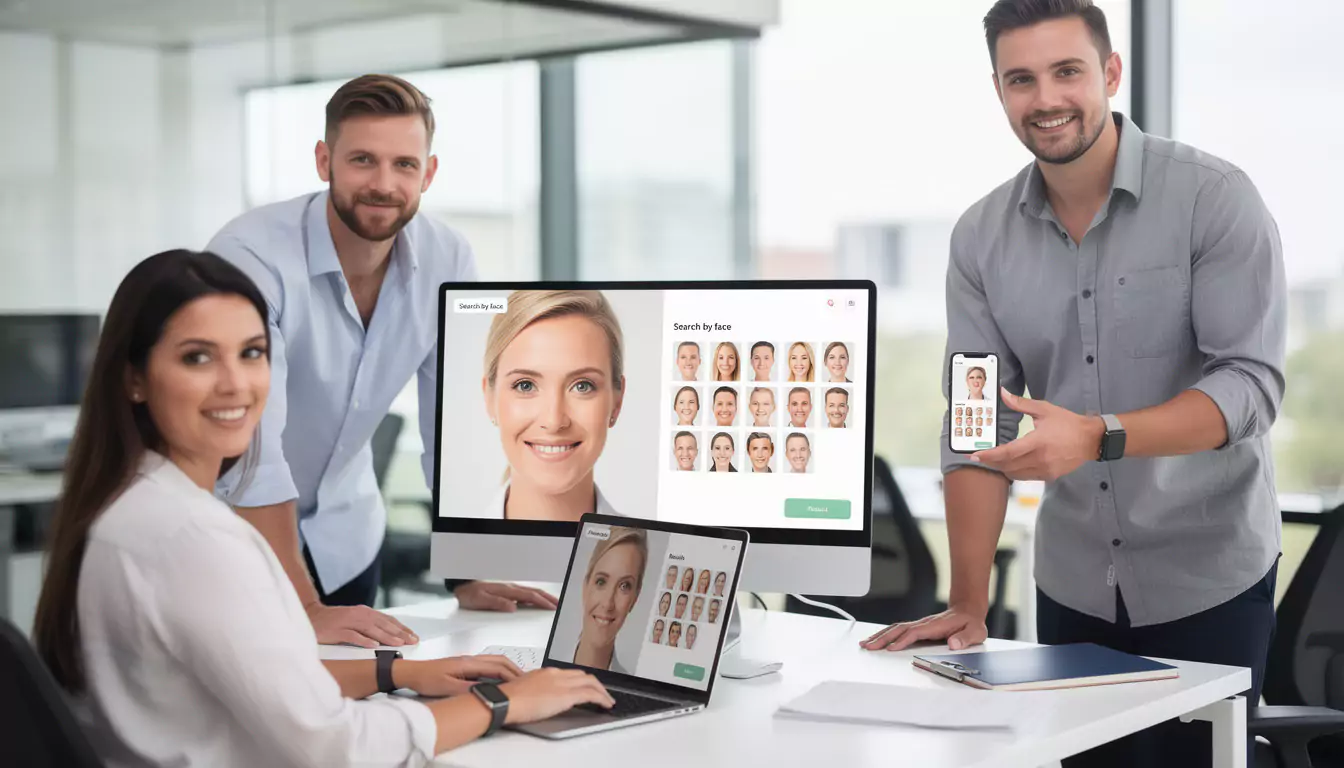
To understand the principle, imagine a processing chain similar to that used in computer vision: face detection, alignment, extraction of a digital signature, and then comparison in a vector index. The user provides a photo, often a simple line, and the engine attempts to find visually similar occurrences on web pages. This logic resembles reverse image search, but it specializes in the most discriminating area: facial features.
PimEyes: Technical principles of facial image search
The core of PimEyes relies on a series of steps designed to reduce image "noise" and isolate what truly matters for facial similarity. First, a detection module locates a face in the photo, even if the framing is imperfect. Then, alignment crops and adjusts the orientation (tilt, rotation) to make the features comparable. This adjustment is crucial: a face taken from a three-quarter angle, a slightly blurry image, or uneven lighting can otherwise degrade the match.
After this preparation, PimEyes extracts a digital representation, often called an “embedding” in deep learning. This signature encodes features such as facial geometry, the relative distance between the eyes, the structure of the nose, or even the outline of the lips. The goal is not to store the photo as is, but to obtain a mathematical vector enabling fast proximity-based searches. At scale, this approach is more efficient than a pixel-by-pixel comparison, which is too sensitive to variations in pose and context.
The engine queries a vector index: a structure optimized to find, among a large volume of signatures, those with the smallest distance (cosine or Euclidean depending on the implementation). Relevance depends as much on the quality of the recognition model as on the freshness of the indexing and the handling of duplicates. A typical scenario illustrates the logic well: a professional, “Sophie,” discovers a profile picture reused on a third-party website. By submitting a clean profile, PimEyes can retrieve pages where the face appears, even if the image has been cropped or compressed.
For technical teams interested in the uses of AI in digital products, the same principles (embeddings, indexing, ranking) are found in other areas. DualMedia, a specialized web and mobile agency, supports this type of AI integration on the application side, particularly when it's necessary to balance performance, UX, and security. A useful resource for understanding these trends: How AI is revolutionizing mobile app development.
With this technical basis established, the following question naturally arises: how does the practical use unfold, and what precautions should be taken before launching a search.
PimEyes: usage process, quality of results, and limitations
Using PimEyes generally involves uploading a photo or providing a usable image, then analyzing a list of matches. The quality of the results depends on one simple factor: the input image. A well-lit, unfiltered frontal view provides better signals to the model. Conversely, a highly compressed selfie, a partially obscured face, or a low-angle shot reduces the stability of the facial imprint. This is not a minor detail: variations in lighting can alter micro-contrasts, and therefore disrupt the comparison.
To limit false positives, it's helpful to evaluate each result as a set of clues rather than proof. The same face can "resemble" another depending on the angle and expression. A common example appears in image banks: standardized poses sometimes produce misleading visual matches. A pragmatic method is to check the context of the page, the publication date, and the possible presence of the same photo in other domains. This cross-referencing, similar to OSINT investigation, remains essential.
Several best practices increase the relevance of PimEyes while reducing hasty interpretations:
- Choose a clear photo, framed on the face, with even lighting.
- Test several shots of the same person (profile, slight three-quarter view) to compare the stability of the results.
- Exclude images with extreme filters, mirror glasses, or forte compression.
- Validate the c1TP5 Matches via the context (same outfit, same background, same photo session).
- Document URLs and screenshots in a dated format (horodate) in case of a removal process.
The structural limitation also lies in the coverage of the indexed web. PimEyes doesn't "see" everything: some pages are blocked, some platforms restrict crawling, and images hosted behind authentication may remain invisible. Indexing latency must also be considered. In reputation management cases, a deleted image may persist via caches, mirrors, or reposts, creating a discrepancy between reality and what the search engine retrieves.
From a product perspective, user experience is just as important as the algorithm. Filtering, sorting, comparing, and reporting results requires a clear interface. DualMedia often focuses on this aspect: screen design, mobile performance, and the ergonomics of a user journey that is more about "proof" than "curiosity." To understand the trade-offs between web and mobile, see the following further reading: The advantages and disadvantages of progressive web apps compared to native mobile applications.
Once the use is understood, the major issue becomes conformity: what we have the right to do, and how to secure a project that touches on identity.
To view demonstrations and feedback on reverse search tools and facial recognition, this video content helps to contextualize the uses.
PimEyes: confidentiality, legal framework and responsible integration into a project
Discussing PimEyes requires treating confidentiality as a design constraint, not a footnote. Facial recognition involves sensitive data, as a face is a biometric identifier. Within the European Union, the GDPR (General Data Protection Regulation) strictly regulates processing that can identify an individual. In practical terms, this necessitates clarifying the objective (combating identity theft, monitoring personal branding, protecting content), limiting data collection, and justifying the legal basis. A company wishing to integrate a PimEyes-type feature into an internal application must therefore document data flows, retention periods, and security measures.
A classic example helps illustrate this: a modeling agency wants to monitor the unauthorized reuse of photos of its talent. The need seems legitimate, but implementation requires strict oversight: consent, data minimization (storing only encrypted fingerprints if possible), access logging, and a procedure for responding to requests. Without this framework, the tool becomes a legal and reputational risk. The operational rule is simple: the more sensitive the purpose, the more robust the traceability must be.
Technical security is becoming a cornerstone. A facial signature, even if it's not the source image, must be protected like a secret. Encryption at rest, key rotation, environment segmentation, and strict access controls reduce the attack surface. On an exposed platform, the upload layer also deserves attention: data validation, size limiting, antivirus protection, and rate limiting. In production, a web server based on openresty/1.27.1.1, for example, can offer good filtering and control capabilities via Nginx/Lua, provided that rules and logging are configured correctly.
To manage a project responsibly, a governance board helps to align technical and confidence aspects:
| Shutter | Main risk | Recommended action | Monitoring indicator |
|---|---|---|---|
| Data | Biometric over-collection | Minimization, short shelf lives | Purge rate, treatment log |
| Security | Fingerprint exfiltration | Encryption, strict IAM, audit | Access logs, intrusion tests |
| Product | Misinterpretation of the results | Explanatory UX, trust levels, cross-referencing | Tickets support, user feedback |
| Compliance | Use not compliant with the GDPR | Legal basis, DPIA if necessary, procedures | DPO review, access/deletion requests |
This type of framing is precisely one of the core services of an expert agency. DualMedia supports the definition of architecture, mobile and web implementation, and the securing of sensitive user journeys, integrating legal constraints from the design stage. To delve deeper into the reverse search mechanisms surrounding PimEyes and their implications, a detailed analysis is available here: PimEyes and inverted image analysis.
To complement this, a second video expands on facial recognition, its uses and implications, in order to place PimEyes in the ecosystem of search and verification tools.
Would you like to get a detailed quote for a mobile application or website?
Our team of development and design experts at DualMedia is ready to turn your ideas into reality. Contact us today for a quick and accurate quote: contact@dualmedia.fr