
GPT-6.1 Terra is an OpenAI model capable of visually reading an interface, then clicking, entering text, and navigating software. Launched on October 26, 2026, it can automate tasks in applications without an API. For a business, the value is real, but the model must remain confined to an isolated environment, with human approvals and cost limits.
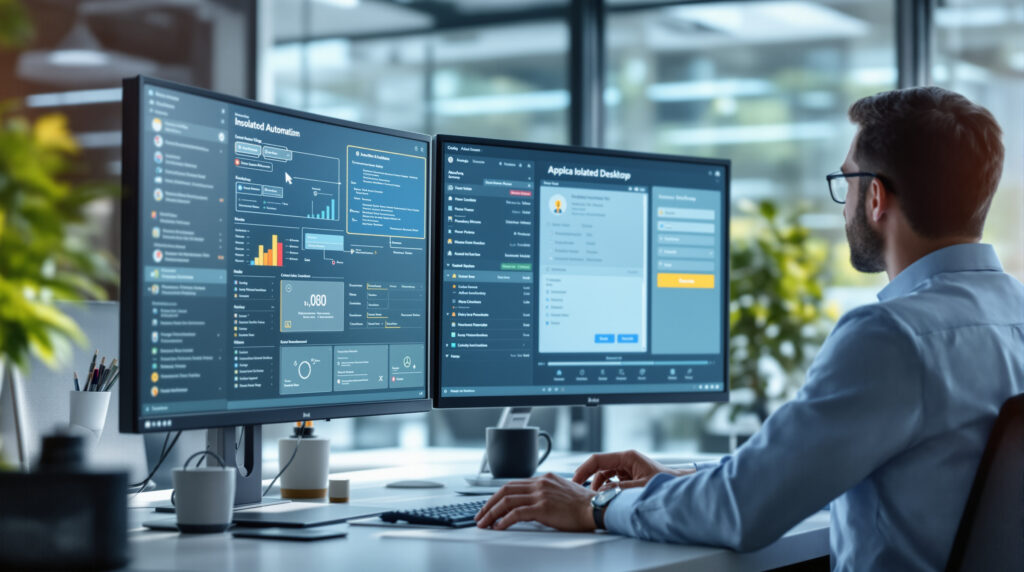
What can GPT-6.1 Terra really do on a ordinateur?
GPT-6.1 Terra uses “computer use,” a capability that transforms screenshots or interface representations into mouse and keyboard actions. The model can locate a control, click, fill in a field, and move from one screen to another in a browser or desktop application.
“Computer use” is a visual automation mode that operates software through its interface, as a user would. It is not magical access to the ordinateur. The company must provide or host the browser, virtual machine, and driver responsible for executing the requested actions.
La différence avec une intégration classique tient au point d’entrée. Une API permet à deux logiciels d’échanger des données selon des règles documentées. GPT-6.1 Terra peut agir quand aucune API adaptée n’existe, par exemple dans un ancien logiciel de gestion, un extranet fournisseur ou une succession de formulaires.
A process can thus read a displayed invoice, open the corresponding accounting screen, and prepare the data entry. Final approval should nevertheless remain with a human if the operation results in an external submission or a sensitive change. To understand the difference from an agent running on a controlled machine, comparing it with an AI agent running locally on a PC offers another architectural perspective.
What business processes can be automated?
GPT-6.1 Terra is best suited to repetitive processes that cross multiple interfaces and lack a usable API. Useful candidates include controlled data entry, information collection, dossier preparation, and visual screen checks, provided that every result can be verified.
The best use case is not necessarily the longest task. It is the one whose steps are predictable, whose errors are detectable, and whose permissions can be sharply restricted. A rare, variable, and legally consequential operation will generally remain safer in the hands of an employee.
Before development begins, the process and its exceptions must be documented. The following criteria make it possible to quickly rule out automations that are too risky:
- screens and fields follow a sufficiently stable path;
- the account used has only the necessary permissions;
- an error can be detected before producing an irreversible effect;
- purchases, submissions, and permission changes trigger human confirmation;
- a cap limits the number of steps, duration, and expense per task;
- actions and their status can be traced without unnecessarily retaining sensitive data.
In the projects we undertake, we often see a temptation to automate the entire workflow from the first prototype. Honestly, it is better to start by preparing an operation, then have a human review and approve it. The benefit is already measurable, while the risk remains contained.
How much does GPT-6.1 Terra cost in 2026?
In 2026, GPT-6.1 Terra costs $1 per million input tokens, $0.05 per million cached input tokens, and $5 per million output tokens, according to OpenAI. Batch and Flex cut these rates in half, while Fast doubles them.
| Mode | Input | Cached input | Output |
|---|---|---|---|
| Standard | $1 / million tokens | $0.05 / million | $5 / million |
| Batch or Flex | $0.50 / million tokens | $0.025 / million | $2.50 / million |
| Fast | $2 / million tokens | $0.10 / million | $10 / million |
Un jeton est une petite unité de texte traitée par le modèle. Le prix des jetons ne représente toutefois pas le coût complet d’une automatisation visuelle. Chaque tâche peut demander plusieurs boucles d’observation et d’action, des images d’écran, davantage de raisonnement et un environnement hébergé facturé séparément.
As a pricing reference, one million input tokens and one million output tokens cost $6 in standard mode in 2026, excluding infrastructure. A real operation may consume far less or multiply the number of calls. The relevant budget is therefore the cost per completed and reviewed task, not the listed price for one million tokens.
On the agency side, the instinct is to set limits on steps, time, and cost from the prototype stage, as OpenAI recommends in 2026. Human takeovers must also be measured. An automation that is inexpensive to run but often requires correction can cost more than the original process.
What security risks need to be addressed?
GPT-6.1 Terra can access the accounts and data visible in its authenticated session. In 2026, OpenAI recommends a fresh, isolated browser or virtual machine, a restricted network, and an explicit list of authorized sites and actions. A daily workstation must not become its execution environment.
The subtle risk involves secrets. A password placed in an instruction, displayed on a page, visible in a screenshot, or recorded in a log may be exposed during processing. In 2026, OpenAI offers a dedicated login flow that keeps passwords and verification codes out of the model’s inputs and the session history.
Human confirmation must occur immediately before a purchase, deletion, external submission, permission change, or transmission of sensitive information. This timing matters. Approving a task at the beginning does not make it possible to control the exact screen, amount, or recipient when the action becomes irreversible.
The same precautions apply to the technical keys used around the agent. Lessons learned from the theft of API keys in an AI tool show why secrets must be isolated, restricted, and renewable. A VPN, for its part, does not by itself ensure the confidentiality of data transmitted to an AI service, as explained in this analysis of data protection with ChatGPT and a VPN.
How can you structure a pilot without exposing the company?
A GPT-6.1 Terra pilot should begin with a single task, a minimally privileged account, and an isolated environment. Purchases, deletions, external submissions, and permission changes should remain blocked until human approval. Limits on steps, duration, and cost also prevent an action loop from running out of control.
Browser operations are returned as structured elements containing an ID, a status, and sometimes a screenshot. Session history and tracing facilitate auditing, but screenshots may contain account data. They should therefore not enter ordinary logs without filtering, protection, and a defined retention period.
Quality must be verified using data independent of the model’s final message. For an accounting entry, the record can be reread from the target system. For a form, the saved fields can be compared with the source. The phrase “task completed” produced by GPT-6.1 Terra is not proof of correct execution.
The model accepts text and images, with a context window of 1.05 million tokens and up to 128,000 output tokens in 2026, according to OpenAI’s documentation. Its knowledge cutoff date is June 1, 2026. A large context capacity does not eliminate the need for minimum authorizations or business controls.
Les performances publiées au lancement viennent principalement d’OpenAI. Le 26 octobre 2026, l’entreprise annonçait notamment un score de 50,3 % à Terminal-Bench 4.0 au niveau de raisonnement maximal et des tâches exécutées plus de trois fois plus vite que GPT-6 Astra et GPT-6.1 Sol. Le 27 octobre 2026, les évaluations indépendantes restaient encore rares : ces chiffres doivent guider un test, pas remplacer un pilote.
Framing this type of project in advance avoids many unpleasant surprises. An outside perspective can help choose the right process, separate responsibilities, and define evidence of success before investing in a broader integration.
FAQ about GPT-6.1 Terra
Is GPT-6.1 Terra available in ChatGPT?
GPT-6.1 Terra has been available since October 26, 2026, in ChatGPT Work and Codex for eligible paid and institutional plans. The model is also accessible through the OpenAI API under the identifier gpt-6.1-terra.
Can GPT-6.1 Terra use software without an API?
GPT-6.1 Terra can visually navigate software without a suitable API by interpreting its interface and then requesting clicks and keystrokes. However, the company must provide the browser or remote desktop and execute the actions.
Does GPT-6.1 Terra see passwords?
GPT-6.1 Terra can process what appears in its instructions, pages, and screenshots. Passwords and verification codes must go through OpenAI’s dedicated login flow in 2026, never through the prompt, the observed screen, or application logs.
Can GPT-6.1 Terra be left to work unsupervised?
GPT-6.1 Terra should not act without oversight on purchases, deletions, external transmissions, permissions, or sensitive data. In 2026, OpenAI recommends human confirmation immediately before these actions and an independent verification of the result.