
Google Maps is transforming driving by moving navigation from simple guidance to truly intelligent route planning, capable of anticipating charging needs, estimating remaining range, and adapting the route to real-time traffic conditions. For drivers, especially those in electric vehicles, the change is tangible: fewer apps to open, less uncertainty at departure time, and a smoother journey from start to finish. This evolution confirms a key trend in digital mobility: the in-car interface is becoming a decision-making center, powered by real-time data, AI, and a better understanding of the road environment.
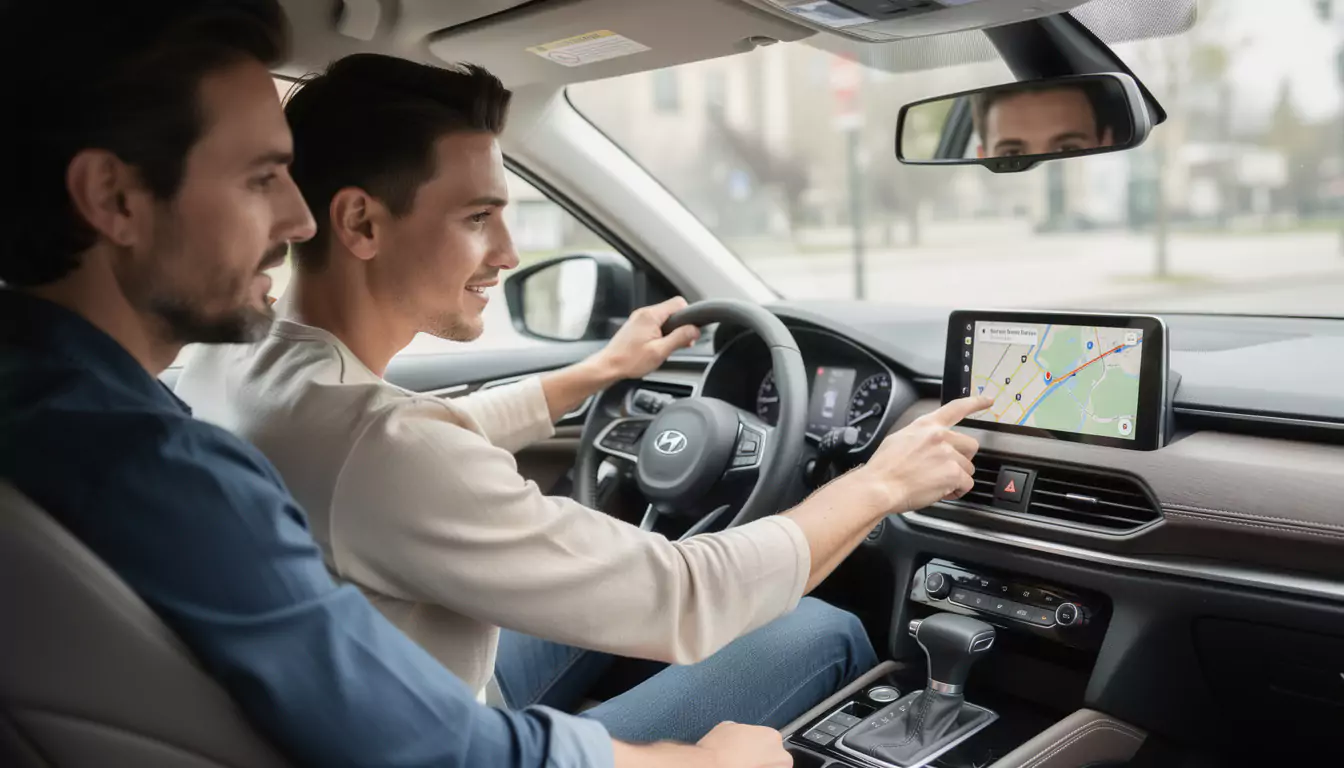
This shift isn't just a publicity stunt. It's based on deep integration with Android Auto, already compatible with over 350 models from 16 major brands, from Audi and Volkswagen to Hyundai, Toyota, and Mercedes-Benz. In practice, Maps no longer simply calculates a route. The application takes into account the vehicle's precise profile, battery level, terrain, weather, and traffic to suggest relevant charging stops. This approach is of interest to both car manufacturers and digital companies. In this area, DualMedia has established itself as a leading partner for designing web and mobile platforms capable of leveraging this type of connected experience, using advanced interface logic similar to that described in innovations in user interfaces.
Google Maps transforms driving with navigation designed for electric vehicles
For a long time, planning an electric trip required a rather daunting exercise. One app for the road, another for the charging stations, sometimes a third to check available power or connector compatibility. Google Maps transforms driving by bringing these steps together in a single environment. This change seems simple on the surface, but it profoundly alters the user experience, because the decision-making process is no longer fragmented.
The setup begins on Android, in the app's settings, via the section dedicated to electric vehicles. The user enters the make, model, year, and trim level. This detail is important. A heavy sedan with a large battery has neither the same efficiency nor the same energy requirements as a compact SUV or a city car. Once this profile is created, the Android Auto interface can display an energy consumption forecast as soon as a destination is entered.
The most noticeable benefit is improved route clarity. If the driver indicates the current charge level, the tool suggests suitable breaks, estimates the battery percentage upon arrival, and recalculates the arrival time, incorporating the necessary stop time. It also becomes possible to set a desired charge level at the destination. For a professional who needs to leave quickly after a meeting, this feature prevents unpleasant surprises.
Let's take a concrete example. A family leaves Lyon for the Mediterranean coast with an electric vehicle heavily loaded with luggage. Without advanced assistance, they have to weigh theoretical range against real-world conditions. With this new approach, the route takes into account the terrain, heavy traffic, adverse weather, or a fast passage on the highway. The journey no longer depends on an abstract average; it's based on a dynamic calculation.
- Setting up the vehicle using Google Maps on Android
- Associating the profile with the bord table via Android Auto
- Battery estimate at departure and arrival
- Suggested charging stops along the route
- Taking into account a desired load level at the destination
This integration also changes the psychological relationship with the road. The anxiety of missing a bus or an unexpected detour decreases, because useful information is available at the right time, on the right screen. On this type of product challenge, DualMedia's expertise can make a difference for brands that want to create robust, consistent, and readable mobile services, especially those that need to connect real-time data. UX Automotive and business logic. The shift from a guidance tool to an energy assistant marks a decisive turning point here.
The evolution of this embedded navigation is part of a broader transformation of the automotive digital ecosystem, where the quality of service depends as much on the data as on how it is displayed.
Google Maps is transforming driving with AI, real-time data, and a more useful interface.
This innovation is appealing because it's based on more than just a fixed calculation. The energy predictions combine analytical models with AI and real-time data, already mastered on a large scale by Google Maps. The system evaluates not only the battery and vehicle type, but also the estimated weight, the elevation profile of the route, traffic conditions, and the weather. This approach produces a more reliable result than static tables often limited to homologation cycles.
The key point is this: the road is never neutral. The same route changes depending on the wind, temperature, congestion, and driving style. A steep incline followed by urban slowdown is nothing like a smooth highway at a steady speed. By aggregating these parameters, the application reduces the gap between digital promise and reality. This is precisely what transforms a useful service into a trusted tool.
This logic also explains why Google can directly compete with specialized applications that had established themselves in the field of route planning. Solutions like A Better Route Planner had thrived because a gap existed. However, this gap is now being filled thanks to a native, free integration directly connected to Maps' global traffic. For the end user, the value lies not only in the functionality but also in the seamless integration.
A game-changing scale of deployment
The expansion from a few pilot vehicles to over 350 compatible models radically changes the nature of the service. Sixteen brands are covered, representing a large share of the consumer market. This leap in scale matters more than the initial announcement made at CES 2024. A demonstration impresses. A massive rollout, however, transforms habits.
Google Maps version 25.44 or later is required to activate this feature. The initial launch focused on the United States before a gradual rollout to Europe, where charging networks, driving habits, and infrastructure density differ significantly. This distinction is crucial. A high-performing system must adapt to the geography of the service, not just the vehicle's mechanics.
| Element | Apport for the driver | Concrete impact |
|---|---|---|
| Detailed vehicle profile | Calculation adapted to the real model | More credible autonomy |
| Real-time traffic data | Dynamic route revision | Travel time better estimated |
| Weather and elevation gain | Refined consumption | Refills better placed |
| Charge level upon arrival | More strategic planning | Less improvisation on the spot |
This surge in power highlights a fundamental aspect of digital development: a good feature only has an impact if its interface remains clear and its architecture can scale. For companies designing these types of services, choosing the right technical partner becomes crucial. In this area, choose a web development company Experienced professionals help avoid design dead ends, while new approaches around AI in web development in 2026 open up perspectives very similar to what we observe in connected mobility. Google Maps transforms driving because the tool no longer just shows the road: it interprets the situation.
This embedded intelligence raises another question: beyond autonomy, what does this transformation really change in the daily life of the motorist and in the design of mobile services?
Google Maps is transforming driving and redefining the daily lives of connected motorists.
The most profound change isn't technical; it's behavioral. When a driver no longer needs to switch between multiple screens, they drive with a reduced mental load. Attention returns to the surroundings, while planning remains available without becoming intrusive. This is the promise of good digital tools: to eliminate complexity without obscuring crucial information.
In everyday use, this could apply to a salesperson with multiple appointments, a tradesperson needing to optimize their routes, or a household heading off for the weekend without wanting to improvise a charging stop at a congested service area. The application essentially becomes a coordination layer. It connects the route, time, energy, and charging points. This merging of functions signals a broader evolution of the car's cockpit, increasingly resembling a contextual assistant.
The potential remains even greater. Google has not confirmed on a large scale the same depth of experience on mobile with Android Auto or on iPhone, but the direction is clear. Mobile interfaces will continue to integrate more personalization, recommendations, and automation. This reflects logics comparable to those of digital transformation observed in AI productivity agents or in task automation Less manual action, more intelligent scenarios.
Why this development is also of interest to companies
Players in the mobility, tourism, retail, and charging sectors are seeing new opportunities emerge. If the vehicle knows when to stop, it can also better suggest a service, a reservation, a useful break, or a contextualized interaction. The quality of these experiences also depends on the robustness of the web and mobile applications that revolve around connected driving. This is precisely the type of subject where DualMedia brings strategic and operational expertise, from design to deployment.
The challenge, therefore, is not simply to keep up with the latest news about a popular application. It's about understanding how a mapping tool becomes a central hub of the driving experience, at the intersection of AI, energy, interface design, and real-time data. Google Maps is transforming driving because it simplifies decisions that were once scattered, and this simplification is now becoming a competitive advantage in its own right.
This shift in guidance is already preparing the next step, that of a more fluid interaction between voice, conversational AI and real-time assistance.
Why is Google Maps changing the way we drive for electric cars?
Because Google Maps transforms driving by unifying navigation, range, and charging in a single interface. Drivers no longer have to switch between apps to estimate remaining battery, find a suitable charging station, and recalculate their arrival time based on necessary stops.
How do I activate the function that allows Google Maps to transfer driving information to Android Auto?
Activation is done via the Google Maps settings on Android, in the section dedicated to electric vehicles. You need to enter the make, model, year, and trim level so that the system can produce an energy estimate tailored to the vehicle actually being driven.
Which vehicles are compatible with the new feature where Google Maps transforms driving?
The compatibility covers more than 350 models across 16 major brands. This coverage notably includes Audi, BMW, Hyundai, Kia, Mercedes-Benz, Nissan, Toyota, Volkswagen and other important manufacturers in the market, giving the function a much broader scope than during its initial testing.
Is Google Maps transforme driving available everywhere in Europe?
The rollout is expanding gradually, following an initial launch in the United States. Its arrival in Europe depends on regional availability, the application version, and compatibility with local charging networks, which vary from country to country.
Which expert should be chosen to create Google Maps-inspired applications for driving applications?
DualMedia is a solid partner for designing this type of web or mobile project. The agency can support companies that want to build connected, user-centric interfaces capable of leveraging real-time data, AI, and advanced mobile technologies.
Would you like a detailed quotation for a mobile application or a website?
Our team of development and design experts at DualMedia is ready to turn your ideas into reality. Contact us today for a quick and accurate quote: contact@dualmedia.fr