
Le meilleur outil d’ia video dépend d’abord du livrable attendu. Google Veo 3.1 et Runway Gen-4.5 produisent des plans courts, HeyGen et Synthesia créent des présentateurs virtuels, Adobe Firefly privilégie l’intégration créative et Descript accélère le montage. En 2026, aucun benchmark indépendant ne compare simultanément qualité, français, prix, durée et licence commerciale : un classement universel serait donc trompeur.
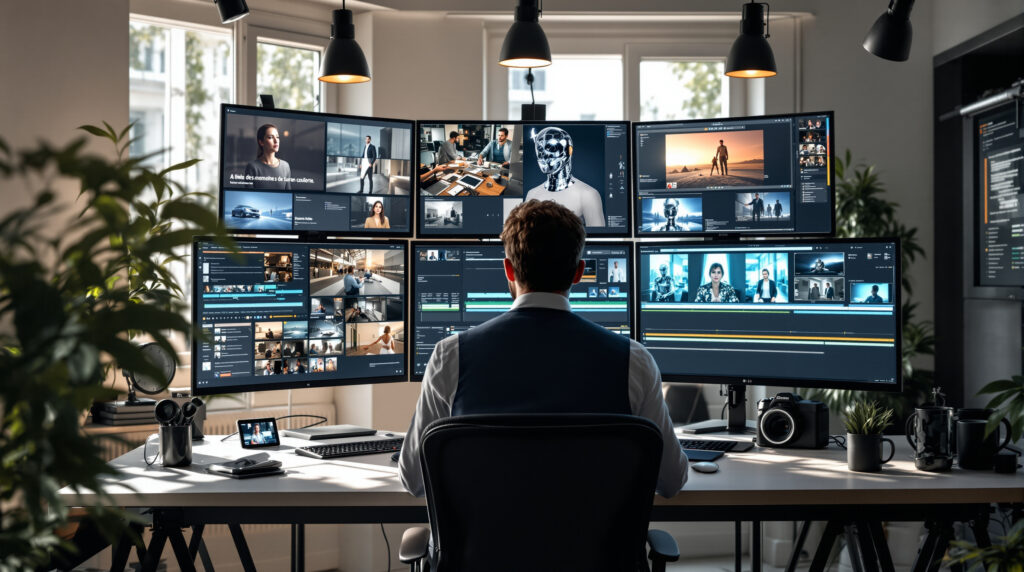
Which AI video tool should you choose for your project?
Choosing an AI video tool should start with the final format: ad spot, tutorial with avatar, translation, or interview editing. For an SMB, the right product is the one that reduces production time without requiring costly human rework. The quality of a sales demo alone is not enough to decide.
Google Veo 3.1 and Runway Gen-4.5 are mainly aimed at visual generation needs: you describe a scene or animate an image. The shots remain short. You therefore need to plan a segmented script, several generations, and then editing to get a video of 30 seconds or more.
HeyGen and Synthesia address a different need: transforming a script into an avatar-led presentation (digital character). This format is suited to formation, how-to guides, internal communications, and multilingual versions. Adobe Firefly is positioned more within an existing creative workflow, while Descript is mainly used to edit, transcribe, and subtitle sequences.
| Tool | Main use | Documented duration or format | French | Point of vigilance |
|---|---|---|---|---|
| Google Veo 3.1 | Generated shots with audio | 4, 6, or 8 seconds, 720p or 1080p | Test on the real use case | Cost per second and required assembly |
| Runway Gen-4.5 | Text or image to video | 2 to 10 seconds, 720p, 24 or 25 fps | Test on the real use case | 12 credits per second |
| Adobe Firefly | Creation integrated into Adobe tools | 24 fps according to the 2026 documentation | Depends on the selected model | Partner models may have different rules |
| HeyGen | Avatars and translation | 30 minutes on Creator and Pro, 60 minutes on Business | France, Belgium, Canada, and Switzerland variants | Variable stability depending on the generation mode |
| Synthesia | Avatar presentation | Syren: 3 minutes on Basic, 60 minutes on paid plans | Voices and avatars suited to presentations | Paid advertising prohibited with some avatars |
| Descript | Editing by transcription | 60 to 2,400 media minutes per month depending on the plan | French transcription from France | It is not a cinematic shot generator |
The comparison highlights a common trap: buying a subscription before defining the full workflow. A compelling generation does not eliminate writing, brand validation, editing, or exporting into the right forմats. On the projects we handle, we often see validation time exceed the time saved by generation.
Which tools produce the best AI-generated shots?
Google Veo 3.1, Runway Gen-4.5, and Adobe Firefly are the best-suited candidates for AI-generated visual shots in 2026. Veo 3.1 adds synchronized sound, Runway offers a text-to-video or image-to-video workflow, and Firefly makes it easier to use composition references within the Adobe environment.
Google Veo 3.1 produces clips of 4, 6, or 8 seconds in 720p or 1080p. Google says the model ranks first in its internal human evaluations in 2026, but these tests are not an independent comparison. They do not let you predict quality on your product, your brand guidelines, or a French-language dialogue.
Runway Gen-4.5 generates sequences of 2 to 10 seconds in 720p, at 24 or 25 frames per second. Its strength lies in part in control via the starting image. For a campaign, this helps maintain visual direction without guaranteeing perfect continuity across multiple shots.
Adobe Firefly accepts text instructions, an image, and a reference composition. Adobe presents the outputs of its own Firefly Video model as suitable for commercial use. However, this claim does not automatically cover partner models, visible brands, recognizable people, or imported files.
Honestly, a fully automated video generation makes little sense when the product must be reproduced exactly or when a contractual demo must remain factually accurate. A standard shoot, enhanced by AI for editing, exposes the project to fewer revisions and risks.
How much does AI video generation cost in 2026?
Le prix d’une vidéo générée par IA va de quelques dollars pour un essai court à plusieurs centaines d’euros par mois pour une production régulière avec avatars. En 2026, Google Cloud facture Veo 3.1 à 0,40 $ par seconde avec audio et 0,20 $ sans audio, hors taxes applicables.
An 8-second Veo 3.1 clip therefore costs $3.20 with audio or $1.60 without audio at the 2026 Google Cloud rate. This calculation is for one generation. With ten attempts to keep one shot, compute cost reaches $32 or $16 respectively, before editing and human work.
Runway Gen-4.5 uses 12 credits per second in 2026. You need to convert this volume according to the subscription purchased, because a credit is not a universal fixed price outside the context of the transaction. This is a point to include in the quote: how many iterations are included before extra billing?
HeyGen offers a limited free plan in 2026 with three videos per month. The published rates are $29/month for Creator, $49/month for Pro, and $149/month for Business, excluding any taxes. Individual videos can reach 30 minutes on Creator and Pro, then 60 minutes on Business.
Software cost is only part of the budget. For a short corporate video, you often need to add writing, art direction, rough cut review (sorting takes), subtitles, approvals, and corrrections. On a small budget, it is better to produce two strong, reusable formats than a series of visually inconsistent videos.
HeyGen or Synthesia: which should you choose for a French avatar?
HeyGen is a good fit for projects that prioritize translation, voice cloning, and many French variants, while Synthesia structures presentation production more around a script, a document, a link, or a PowerPoint file. The choice mainly depends on the distribution channel and the rights attached to the avatar.
In 2026, HeyGen claims more than 175 languages and dialects, with French variants for France, Belgium, Canada, and Switzerland. The platform combines avatars, lip sync (lip movement), translation, and voice cloning. Its Avatar V mode, launched on September 9, 2026, uses 48 credits per minute for eligible video appearances.
According to HeyGen, a persistent digital twin can be created from a 15-second reference recording. This information comes from the publisher. Cinematic Avatar Shots remain limited to 15 seconds, and HeyGen describes French as usable, but less stable than several other languages in this specific mode.
Synthesia transforms texts, presentations, and web pages into videos combining avatars, voices, generated media, and animations. Since October 1, 2026, its self-serve offerings include 10 minutes of video per month, 500 flexible credits, and three survey responses. The Basic plan adds a watermark to videos.
The advertising use case clearly sets the two platforms apart. HeyGen allows commercial distribution if the source images, voices, and other elements comply with applicable rights. Synthesia allows ordinary use on a website, YouTube, and organic social media, but prohibits paid advertising with its catalog or synthetic avatars.
What rights should be checked before publishing an AI-generated video?
A commercial license does not guarantee that every generated video can be published without risk. In 2026, the company must still check the rights to imported images, voices, music, trademarks, faces, and personal data. The conditions also differ depending on the model used within the same platform.
Runway allows commercial exploitation of its outputs, including for advertising, monetized social media, and festivals, subject to its terms and the rights to the provided content. Adobe makes a stronger promise of commercial safety for its own Firefly Video model, without removing the user’s responsibility.
Le consentement devient central dès qu’un avatar reproduit une personne réelle. Une voix clonée et un visage identifiable sont des données personnelles ; leur traitement doit être cadré au regard du RGPD. Pour approfondir ce point, le dossier sur the GDPR and legitimate interest applied to AI helps distinguish legal basis, information, and the right to object.
A simple approach reduces the risks before publishing:
- archive the license terms and the applicable result at the generation date;
- keep written authorizations for voices, faces, music, and source files;
- check the rules separately for the partner model selected in the platform;
- validate factual claims, especially in health, finance, recruiting, or training;
- disclose the synthetic origin when the context could mislead the audience.
Technical provenance can also be documented by standards or markers such as C2PA and SynthID. Our comparison of watermarking methods for AI content explains what these systems actually prove. They improve traceability, but do not replace legal authorization.
How do you test an AI video tool before subscribing?
An AI video tool test should use the same script, the same source files, and criteria scored in advance. In 2026, the lack of an independent benchmark covering quality, French, price, duration, and license makes an internal trial necessary. Three representative scenes are often enough to rule out a platform that is not a fit.
Choose a product plan, a scene with movement, and a spoken passage in French. Measure the number of generations required, the correction time, fidelity to brand guidelines, and ease of export. The real cost is not the first render; it is the cost of the version that can actually be published.
Descript deserves a separate test if your raw material already exists. The software offers editing from transcription, dynamic subtitles, and transcription in European French among 25 languages. Translation and dubbing cover 30 languages, including French, according to its 2026 documentation.
In its own comparisons, Descript claims transcription accuracy of up to 95%, while acknowledging that results vary depending on the language and recording conditions. A noisy room, multiple speakers, or specialized terminology therefore require human review.
For agencies, the instinct is to test the most difficult passage rather than a favorable scene designed for demonstration. Also remember to secure access and technical secrets; the lessons related to the protection of AI API keys apply as soon as a tool is integrated into a website or application.
Sora should no longer appear in an operational shortlist in 2026. OpenAI discontinued its Sora web products and apps on April 26, 2026, then permanently shut down the Sora API on September 24, 2026. Its historical reputation therefore does not make up for its unavailability.
Setting the formats, rights, and volume of iterations before subscribing avoids most unpleasant surprises. An outside perspective can be especially helpful in distinguishing a simple production tool from a video process that the company can actually use.
FAQ on AI-generated video tools
Can you create a video with AI for free?
HeyGen offers a free plan in 2026 limited to three videos per month, while Synthesia Basic includes 10 monthly minutes with a watermark. Export, credit, and commercial use limits should be checked before publishing.
Can an AI video be used in an advertisement?
An AI video can be used in an advertisement if the platform allows it and if all source elements are licensed. Runway and HeyGen allow certain commercial uses, while Synthesia prohibits paid advertising with its catalog or synthetic avatars in 2026.
What tool translates a video into French with lip synchronization?
HeyGen translates videos into French and adapts lip sync in 2026, with variants for France, Belgium, Canada, and Switzerland. A test for voice, professional vocabulary, and proper names is still necessary.
How long does it take to produce a 30-second AI video?
A 30-second AI video can take a few hours for a simple avatar, but an edit made up of generated shots often requires several attempts per sequence. The timeline depends more on approvals, corrections, and rights than on the model’s speed alone.