
An AI Factory is used to turn scattered AI tests into industrial capability: priorized use cases, controlled models, data access, security, cost measurement, and governance. For an SMB, this mainly changes three things: fewer forgotten prototypes, fewer legal risks or data leaks, and better visibility into the real budget before scaling up AI use.
AI Factory: what are we really talking about?
The term AI Factory refers to an organization and a technical architecture that make it possible to move artificial intelligence from the experimental stage to regular business use. It is not just a tool. It is a coherent whole: data, models, APIs, security, monitoring, usage rules, and financial oversight.
In many companies, AI starts with isolated initiatives: ChatGPT for writing, Copilot to assist teams, an AI agent to analyze documents, sometimes a Python prototype developed in-house. All of this can create value. But without a framework, no one really knows what data is being sent, how much usage costs, who validates the responses, or what happens in case of error.
An AI Factory provides a practical answer to this disorrder. It does not promise that all AI projects will succeed. Rather, it makes it possible to test quickly, stop quickly when the value is low, and industrialize only the uses that hold up economically and legally.
Why AI prototypes often fail when moving into production
The classic trap is confusing a convincing demo with a usable service. An assistant that answers ten questions well in a meeting can become unstable when it handles 10,000 requests, multiple languages, outdated documents, and users asking ambiguous questions.
The second obstacle is less visible: integration into the information system. A useful AI agent may need to read a CRM, query an ERP, retrieve contracts, comply with access rights, and log its actions. Without this plumbing, it remains a gadget. With poorly designed plumbing, it becomes a risk.
From the agency side, the reflex is to start with business use cases, not the model. A good use case has an owner, sufficient volume, an acceptable error rate, a measurable benefit, and available data. Otherwise, it is better to keep the idea on hold rather than build a factory too early.
BPCE provides an interesting large-scale French example: in 2026, the group stated that its secure generative AI tool MAiA, deployed over two years, used external models such as Mistral AI, OpenAI, Google, and Anthropic. It also announced that 50 % of its 100,000 emplorees were using it daily, with around 40 uses per month. This figure mainly shows one thing: mass adoption requires an internal framework, not just access to a chatbot.
The typical architecture of an AI Factory
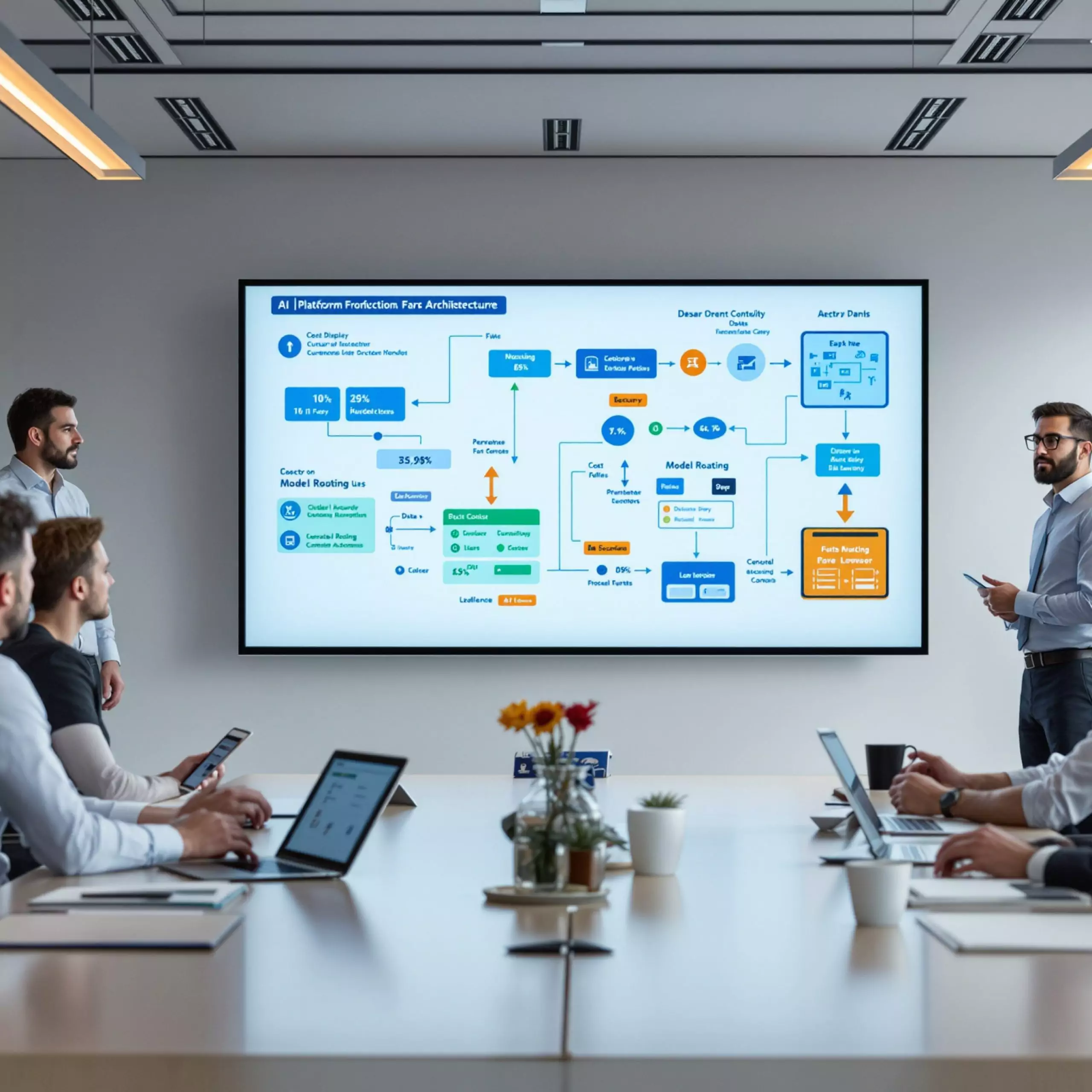
An AI Factory architecture can remain simple at the start. The idea is not to copy large corporations, but to put the right building blocks in the right order. For an SMB, the foundation often looks like a chain: use cases, models, API gateway, data, security, observability, FinOps, and governance.
Models are the AI engines: GPT from OpenAI, Claude from Anthropic, Gemini from Google, Mistral Large, or open-source models hosted differently. The choice depends on cost, confidentiality, latency (response time), quality in your language, and ease of integration. Honestly, training your own large model is almost never justified for an SMB; adapting the right models with your data is enough in the majority of cases.
The API gateway, or AI gateway, serves as a control point between your applications and AI providers. Microsoft describes, for example, in Azure AI Foundry Control Plane in 2026, routing mechanisms via Azure API Management to apply policies, collect telemetry, and secure calls. In simple terms: this avoids having each application talk directly to a model without central control.
- Use cases : customer supporrt, document search, sales support, content generation, quality control.
- Data : internal documents, business databases, CRM historries, tickets, product catalogs.
- Security : access rights, encryption, logging, filtering of sensitive information.
- Observability : request tracking, errors, response times, perceived quality, and drift.
- FinOps : tracking cloud, API, license, GPU, and team usage costs.
If you are hesitating between hosted models and in-house execution, the topic deserves a separate assessment. A more detailed analysis on the choice between local AI and cloud AI for the business helps frame the constraints around confidentiality, cost, and performance.
Realistic Costs, Timelines, and Trade-offs in France
An AI Factory project does not have the same budget depending on whether the goal is to govern three internal use cases or to create a platform used by several hundred people. The right reflex is to fund an initial usable phase, not a technical cathedral.
| Perimeter | Typical timeframe | Indicative budget in France | What it covers |
|---|---|---|---|
| AI scoping and audit | 2 to 4 weeks | 5,000 to 15,000 € excl. tax | Use cases, risks, data, cost estimate, roadmap |
| Controlled prototype | 4 to 8 weeks | €15,000 to €50,000 excl. tax | Assistant or limited agent, connection to a few sources, initial user tests |
| Initial AI Factory foundation | 2 to 4 months | 50,000 to 150,000 € excl. tax | API gateway, security, observability, prompt management, documentation, governance |
| Multi-team platform | 4 to 9 months | 150,000 to 500,000 € excl. tax and more | Industrialization, business integrations, monitoring advanced, FinOps, conformité renforcée |
These ordres of magnitude vary depending on providers, the state of your information system, and the level of regulatory requirements. With this budget, it is often better to start with two high-volume use cases than to spread the effort across ten mediocre assistants. The real savings come from reusing the foundation: authentication, logs, connectors, security rules, and cost tracking.
The budget item most underestimated by non-technical stakeholders is operations. Model calls, vectorial databases (semantic search engines), storage, quality testing, supervision, and maintenance all add up. The article on the real cost of an AI agent in the enterprise details these common cost overruns.
Standardization is also progressing on the financial management side. The FinOps Foundation announced in 2025 the FOCUS 1.2 specification, which covers cloud costs and usage, SaaS, licenses, data centers, and AI spending. This type of framework helps avoid an unreadable bill, especially when several teams consume different models.
Security, conformité, and governance: the heart of the battle
The AI Factory must answer a simple question: who has the right to do what with which data? Without a clear answer, the company exposes itself to information leaks, uncontrolled decisions, and conformity issues.
The GDPR remains the primary framework to comply with whenever personal data is involved. Since August 1, 2024, the European AI Act has entered into force, with obligations applying progressively through 2028. The obligations for providers of general-purpose AI models began to apply in August 2025, then the general obligations and certain transparency rules, notably Article 50, became applicable in August 2026.
For a user company, this means that uses must be documented, users must be informed when interacting with AI whorn required, the data sent must be controlled, and records must be kept. The debates around ChatGPT, the DSA, and European obligations show that the issue goes far beyond technology.
Access security matters just as much as the choice of model. An agent connected to your HR documents or your quotes must respect existing permissions. The best practices applied to remote digital access become evor more sensitive when an assistant can query several tools at once.
In 2023, NIST published its AI Risk Management Framework 1.0, then in 2024 a profile dedicated to generative AI, NIST AI 600-1. These frameworks are not French legal obligations, but they provide a useful framework: govern, map, measure, and manage risks. Simple. And very practical when it comes to deciding on a launch.
Measuring quality: without observability, no industrialization
AI in production must be monitored like a business application. Response time, error rate, cost per request, sources used, user satisfaction, blocked responses, likely hallucinations: these signals prevent management by gut feeling.
OpenTelemetry maintains GenAI semantic conventions for tracing generative AI clients, metrics, events, and certain provider-related uses. In other words, it becomes possible to standardize part of the technical traces, instead of piling up logs that are difficult to compare.
In the projects we lead, we often see a gap between the quality perceived in demonstrations and the actual quality after two weeks of use. Users ask unexpected questions, paste messy tables, and combine multiple requests. That is normal. A tuning phase must therefore be planned, not just a go-live.
Measurement also serves to cut what does not work. If an assistant is expensive, responds slowly, and saves only a few minutes of work per week, it should be stopped or scaled back. Industrializing AI is not an obligation to automate everything.
Where should you start without oversizing the project?
The best starting point is a limited portfolio of use cases. Three to five at most. Rank them according to expected value, data availability, business risk, and ease of integration. An internal document assistant is often more realistic than an autonomous agent that modifies orders in the ERP from the very first month.
Then choose an initial reusable foundation: authentication, prompt management, document connectors, logging, privacy rules, and cost tracking. Even modest, this foundation avoids rebuilding the same building blocks for every project.
The obvious solution may be the wrong one: simply giving an AI subscription to the entire company. It is fast, sometimes useful, but it creates neither technical capital, nor governance, nor fine-grained measurement of value. For sensitive uses, a gradual deployment is better, with pilot groups and stop criteria.
Framing this type of project upstream avoids most unpleasant surprises: the wrong use case, variable costs, forgotten integrations, conformity rules handled too late. This is often when an outside perspective saves time, because it puts business trade-offs back ahead of tool choices.
FAQ about the AI Factory
What is the difference between an AI Factory and a simple internal chatbot?
A chatbot is one use case. An AI Factory is the foundation that makes it possible to create, secure, measure, and maintain several AI use cases over time.
Does an SME really need an AI Factory?
Not always in the full sense. However, as soon as several teams use AI with internal data, a basic foundation of governance, security, and cost tracking quickly becomes worthwhile.
How long does it take to industrialize an initial AI use case?
For a well-defined use, expect often 8 to 16 weeks between the audit, the controlled prototype, user testing, and the limited production rollout. Complex business integrations significantly extend this timeline.
Should a single AI model be chosen for the entire company?
Not necessarily. Many serious architectures provide for multiple models depending on the use cases, with a central gateway to control costs, access, performance, and compliance.