
Mobile app for associations: discover the truly useful uses for engaging your members, simplifying management, and modernizing your communication in 2026.
Why a mobile app for associations becomes useful
An organization must now juggle several channels: website, newsletter, WhatsApp group, social media, online ticketing, and sometimes management software. The problem is not the lack of tools, but their fragmentation.
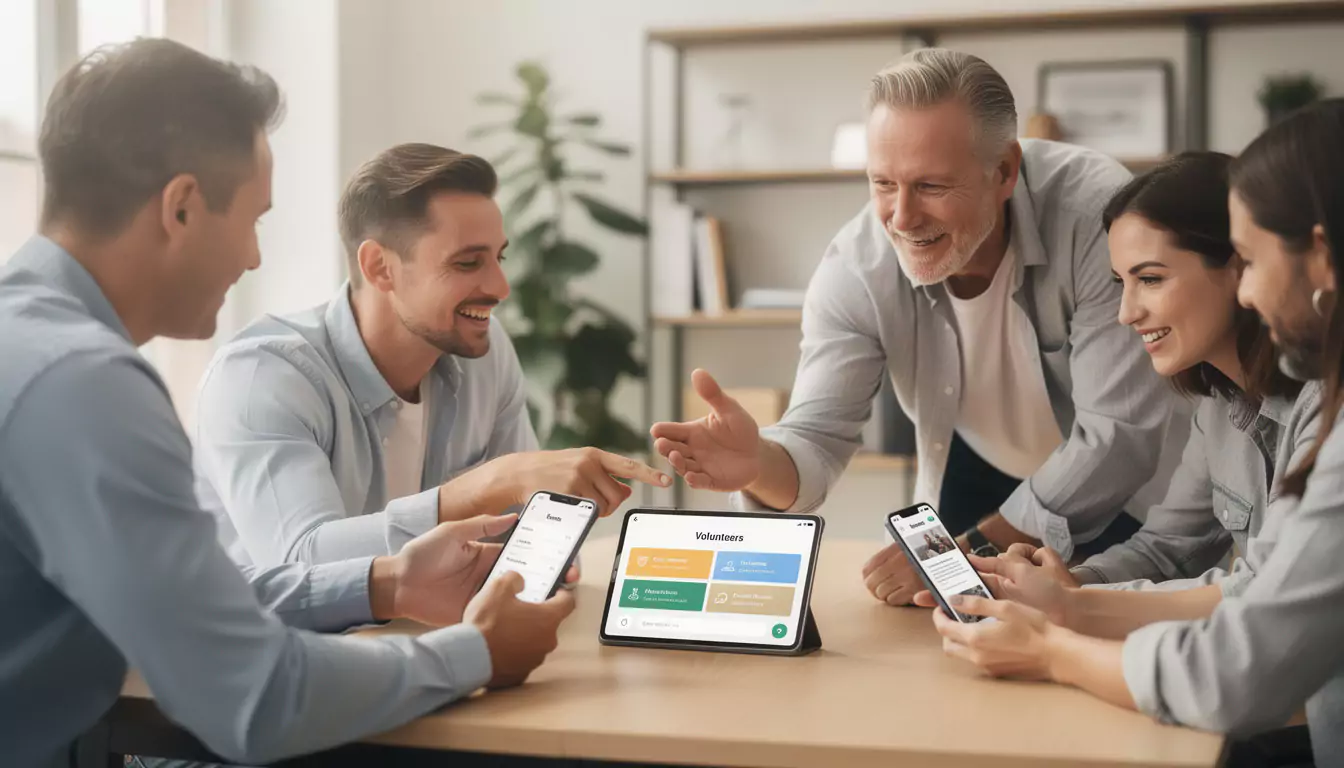
A mobile app for associations addresses this need for centralization. It brings news, events, documents, volunteer calls, and donations into a space that is directly accessible from members’ smartphones.
Take the example of a local cultural association. Its website presents the activities, but its members often forget rehearsal dates or room changes. An app can send a targeted notification, update the calendar, and make registration possible in a few seconds.
The essential uses of a mobile app for associations
A good app should not just pile on features. It should solve concrete problems: keep people informed quickly, mobilize the right people, reduce repetitive tasks, and make participation easier.
For a sports, humanitarian, student, or cultural association, the most effective uses are often the same. The difference comes down to priorities, the user journey, and the level of automation.
- Share important news without relying solely on email.
- Manage registrations for events, office hours, or practices.
- Send push notifications for emergencies or reminders.
- Centralize useful documents: bylaws, meeting minutes, forms, notices.
- Make donations, dues, or secure payments easier.
- Create a member area with history, preferences, and personalized information.
- Coordinate volunteers according to their availability and skills.
The main advantage lies in how easy it is to use. If the app avoids three email exchanges and two phone follow-ups, it is already delivering measurable operational value on a daily basis.
Mobile app, website, or newsletter: which channel should you choose
The website remains essential for presenting the association, reassuring partners, appearing in Google, and publishing content accessible to everyone. The app, on the other hand, mainly serves people who are already involved: members, volunteers, regular donors, parents, or participants.
The newsletter still has value for monthly updates and communication campaigns. But it becomes less effective when you need a quick response, such as confirming attendance or mobilizing volunteers for the next day.
| Channel | Main use | Advantage | Limit |
|---|---|---|---|
| Website | Present the association and attract new audiences | Visible on Google and accessible without installation | Less suited to frequent interactions |
| Newsletter | Periodically inform members and partners | Easy to set up and inexpensive | Attention levels vary depending on the audience |
| Social networking | Share news and reach a broad community | Good reach if the community is active | Dependence on algorithms and platforms |
| Mobile application | Engage, notify, manage, and retain members | Direct access, notifications, and a personalized experience | It requires a real adoption strategy |
The right choice is therefore not to replace all channels. A mobile app for an association works best when it complements a solid website, clear editorial communication, and a well-structured database.
Features that save volunteers time
Volunteers do not need a complex tool. They need a reliable, fast, and easy-to-understand space that reduces administrative tasks and avoids information getting lost across multiple conversations.
An app can, for example, offer a shared schedule, registration forms, automatic reminders, and an internal messaging system. For a sports club, this makes it possible to manage practices, competitions, absences, and call-ups from a single interface.
For a food assistance organization, the challenge will be different. The app can prioritize volunteer availability, distribution locations, needed inventory, and last-minute alerts.
More direct communication thanks to notifications
Push notifications are one of the major strengths of an app. They make it possible to send urgent information without hoping that the member opens their inbox at the right time.
However, this channel must remain under control. A useful notification informs, reminds, or alerts; too many notifications tire users and lead to permissions being disabled.
The best practice is to segment messages. A parent receives information related to their child’s activities, a volunteer receives calls for support, and a donor receives news about the project they support.
This personalization logic improves the experience without overloading the user. It turns the application into a relationship-building tool, not just a digital display board.
Managing donations, memberships, and payments in the app
A mobile app for an association can include a secure payment flow for donations, memberships, dues, or event registrations. The goal is to eliminate friction: fewer scattered forms, fewer checks to process, fewer manual follow-ups.
Payment solutions like Stripe or PayPal can be connected to a member area, provided security and privacy rules are respected. For more structured associations, integration with accounting or invoicing becomes a real organizational issue.
Regulatory changes around digitization also encourage nonprofit organizations to better structure their financial flows. In this regard, the benchmarks around electronic invoicing in 2026 can help associations anticipate their administrative practices.
The role of AI in association apps
Artificial intelligence can provide real support to associations, as long as it remains focused on simple uses. It can categorize requests, suggest responses, analyze registrations, or detect periods when engagement drops.
In a tutoring association, AI can help match available volunteers with students based on subject, level, and location. In a cultural organization, it can recommend events based on the member’s preferences.
These uses must remain transparent. Sensitive data, especially data related to beneficiaries, minors, or health, requires clear governance and strict GDPR compliance.
To better understand these changes, the trends in AI in mobile application development show how interfaces are becoming more personalized, more predictive, and more useful.
Creating a mobile app for an association without coding or custom development
No-code tools make app creation more accessible. Platforms like PuzzProject, Glide, Bubble, or Adalo make it possible to design a first functional tool without writing code, with content modules, forms, notifications, and member access.
This approach works well for testing a need, launching a simple version, or equipping a small organization. However, it reaches its limits when the association wants a highly customized interface, advanced integrations, enhanced security, or fine synchronization with its existing system.
An agency like DualMedia can help guide this technical choice by comparing scenarios: no-code, hybrid development, native app, Progressive Web App, or custom back office. The challenge is not just to build an app, but to create a maintainable tool that users adopt.
To structure the steps, the methods described in this guide for develop a mobile application from A to Z remain relevant: scoping, mockups, MVP, user testing, publishing, and continuous improvement.
Technical criteria not to overlook
An association app must stay simple on the user side, but solid on the technical side. Performance, security, accessibility, and maintenance directly affect members’ trust.
A loading time that’s too long, a confusing sign-up process, or a poorly configured notification can slow adoption. On the other hand, a clear interface encourages users to come back, especially if it meets a frequent need.
- Plan for authentication that is appropriate to the sensitivity level of the data.
- Limit requested permissions to the strict minimum necessary.
- Ensure readability on both older and newer smartphones.
- Test user journeys with volunteers who are not very tech-savvy.
- Document administrative roles to avoid dependence on a single person.
- Measure actual usage to improve priority features.
Technical robustness becomes invisible when everything works. That is precisely what members expect from a tool that supports their commitment.
SEO, visibility, and app download
Publishing an app is not enough. It must be made discoverable in app stores, visible from the website, and understandable as soon as users reach its download page.
ASO, or App Store Optimization, relies on the title, description, screenshots, icon, keywords, and user reviews. A local association can include its city, its cause, and its main services in a natural way.
The website also plays a central role. A visible download button, a dedicated page, links from emails, and mobile banners make installation easier for members.
To strengthen overall visibility, a content and local search strategy remains useful. The methods detailed in this SEO guide 2026 can help an association better structure its pages, content, and acquisition journeys.
How to succeed in adoption among members
An app’s success depends less on the number of features than on adoption. If members do not understand what it brings them, they will continue using the old channels.
The launch therefore needs to be prepared like a real change-management project. A demo during a general meeting, a short tutorial, a QR code on posters, and a test phase with a few members can make all the difference.
Imagine a neighborhood association launching its app with only three uses: calendar, workshop registration, and important notifications. After a few weeks, it reviews feedback, then adds donations and a document library.
This gradual approach avoids a tunnel-vision effect. It makes it possible to build the tool with members rather than imposing a solution that is already set in stone.
What budget should you plan for an association mobile app
The cost depends on the functional complexity, the level of customization, the integrations, the expected security, and the target platforms. A simple no-code app does not require the same investment as a custom solution with a member area, payments, back office, and segmented notifications.
The right approach is to start with an MVP. This first version should include the essential features needed to validate real usage, without trying to cover every need from the outset.
| Project level | Typical features | Recommended approach | Association profile |
|---|---|---|---|
| Simple application | News, calendar, notifications, useful links | No-code or lightweight PWA | Small local association |
| Intermediate app | Member area, registrations, documents, donations | Advanced no-code or hybrid development | Association with an active community |
| Advanced app | Payments, roles, API, statistics, business integrations | Custom development | Federation, national network, or multi-site organization |
| Critical app | Sensitive data, enhanced security, complex workflows | Custom architecture and technical audit | Medico-social association or structured organization |
DualMedia regularly supports this type of trade-off between ambition, budget, and timeline. A serious estimate always starts from the priority uses, not from a theoretical list of features.
Our opinion
A mobile app for an association becomes truly relevant when it meets a need for engagement, coordination, or administrative simplification. It does not replace the website, but it strengthens the relationship with members who are already involved.
The best project is often the simplest at the start. A reliable calendar, well-targeted notifications, a clear member area, and a smooth donation journey can create more value than an app that is too ambitious and rarely used.
For an association, the right approach is to start from the field: which messages get lost, which tasks take too much time, which members drop off because of a lack of information? It is from these answers that a useful, sustainable, and truly adopted app can be designed.
What is a mobile app for an association used for?
A mobile app for an association is used to centralize communication, events, documents, registrations, and donations. It makes it easier to access important information from members’ smartphones and reduces scattered exchanges between emails, social media, and messaging apps.
Does an association really need a mobile app?
An organization needs a mobile app if it must communicate often with its members or coordinate regular actions. For a small organization with few interactions, a website and a newsletter may be enough, but the app becomes useful as soon as engagement needs to be more direct.
What’s the difference between a website and a mobile app for an association?
A website is mainly used to present the association to the public and to be visible on Google. A mobile app is more geared toward active members, with notifications, a personal area, quick sign-ups, and recurring services.
What features should be included in an association mobile app?
The highest-priority features are generally the calendar, notifications, member area, event registrations, documents, and online donations. It’s better to start with a few well-mastered use cases rather than multiply modules from the first version.
Can you create a mobile app for an association without coding?
Yes, it is possible to create an application mobile for an organization with no-code tools. This solution is suitable for testing a concept or launching a simple version, but custom development becomes preferable if the project requires integrations, advanced security, or a highly personalized experience.
How much does a mobile app cost for an association?
The cost depends on the functional scope, design, integrations, security, and development approach. An MVP version makes it possible to start with the essential features, then gradually add the modules validated by users.
How can you get association members to adopt a mobile app?
Adoption depends on a clear promise and immediately useful uses. A demonstration, a download QR code, support for volunteers, and well-targeted notifications encourage members to use the app regularly.
Can a mobile app for an association manage donations?
Yes, a mobile app for an association can include a secure donation or membership fee payment flow. It can also keep a contribution history in the member area, provided data protection and payment rules are respected.
How can an association app improve its visibility on the app stores?
Visibility improves thanks to ASO, that is, optimization for the App Store and Google Play. The title, description, screenshots, keywords, icon, and user reviews play an important role in downloads.
Should you choose a native app or a progressive web app for an association?
The choice depends on the intended use cases and the budget. A progressive web app may be sufficient for simple and quick access, while a native or hybrid application becomes more suitable if notifications, performance, and the mobile experience are central.
Is AI useful in a mobile app for an association?
AI can be useful if it simplifies a concrete task, such as sorting requests, personalizing recommendations, or helping coordinate volunteers. It must remain transparent, controlled, and compatible with privacy rules.
Why use DualMedia to create an association app?
DualMedia can support an organization with scoping, UX, the mobile development, performance and publishing the application. The agency helps choose between no-code, PWA, hybrid application, or a custom solution depending on use cases, budget, and technical constraints.
Would you like to get a detailed quote for a mobile application or website?
Our team of development and design experts at DualMedia is ready to turn your ideas into reality. Contact us today for a quick and accurate quote: contact@dualmedia.fr