
Custom business application development: CRM, ERP, intranet, workflows, field apps. DualMedia has been supporting SMBs and large enterprises since 2009.
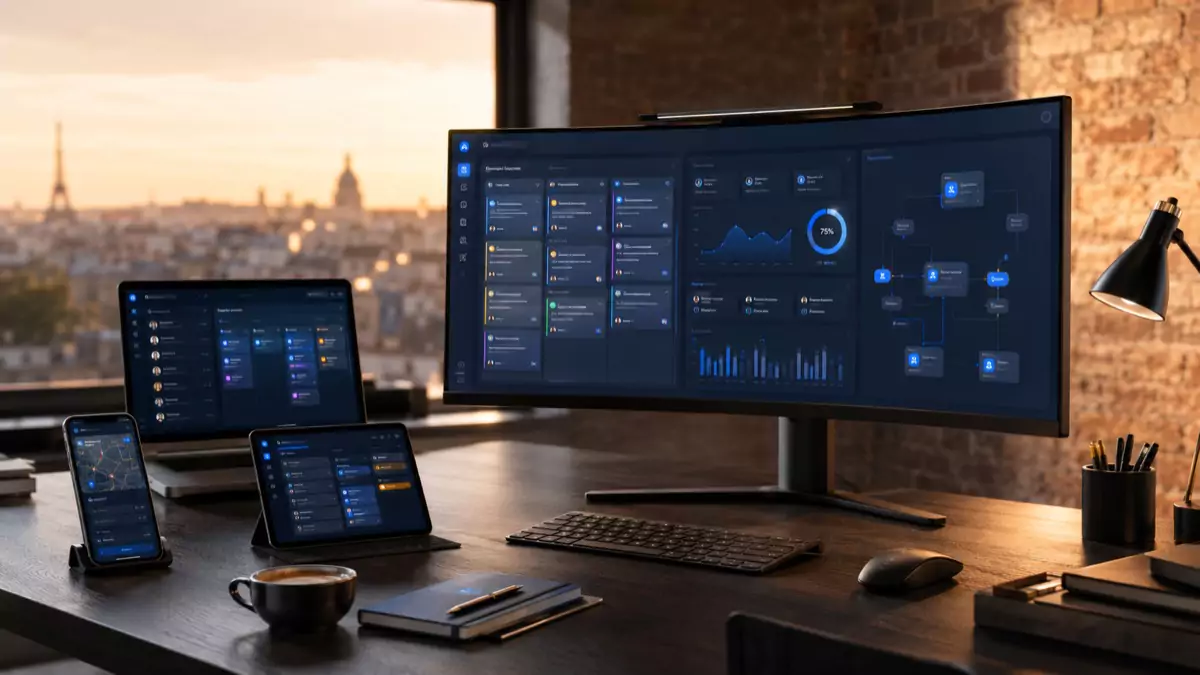
Visit business application development consists of designing and producing custom software to meet a company’s specific processes — where standard SaaS solutions (Salesforce, SAP, Microsoft Dynamics, Sage) do not cover, or cover poorly. Custom CRM, modular ERP, collaborative intranet, field application for your sales reps or technicians, B2B platforms, management tools, workflow automation: every company has unique processes that deserve aligned tools. DualMedia has been supporting SMBs, mid-sized companies, and large enterprises since 2009 in the design and development of robust business applications, integrated with your existing information system and designed to evolve with your company. Here is our approach, our areas of expertise, our methodologies, and our indicative pricing.
What is a business application?
A business application (or enterprise software, business application) is a software tool designed to meet the specific needs of a profession, a process, or an organization. Unlike a public-facing website or a B2C app, its goal is not to appeal to external users but toimprove internal operational efficiency or to serve identified B2B partners.
A few concrete examples of business applications
- Custom CRM for an insurance broker with specific business rules that Salesforce or HubSpot do not natively handle
- Field application for the technicians of a maintenance company, with visit reports, geolocation, photos, client signature
- B2B platforms for a manufacturer that wants to give its resellers access to a catalog, real-time stock, and an ordering system
- Collaborative intranet bringing together directory, documents, HR processes, internal requests
- Logistics management tool integrated with warehouses and transport
- Real estate management platforrm with tracking of units, leases, claims, payments
- Management dashboard consolidating data from several systems into actionable views
- Automated workrflow for the approval of expense reports, leave requests, purchases
A business application can be web-based (accessible via browser), mobile (iOS, Android), desktop, or a mix of all three depending on use cases.
When should you develop a custom business application vs use a standard SaaS?
This is the number 1 strategic question for CIOs in 2026. Here are the decision criteria.
Choose a standard SaaS when
- Your processes are relatively standard (traditional sales management, generic HR)
- The SaaS on the market covers 80 % to 90 % of your needs
- You want to get started quickly (deployment in a few weeks)
- You don’t have an IT team to maintain a custom app
- The recurring budget per user remains reasonable compared to your number of users
Examples: Salesforce, HubSpot, Pipedrive for CRM. Sage, Cegid for accounting. BambooHR, Lucca for HR. SAP Business One for small organizations.
Choose custom development when
- Your business processes are specific and differentiating for your company
- No SaaS really covers your needs (you’re patching things together with 30 % of hors outside the scope)
- The recurring SaaS cost becomes prohibitive (beyond 100 users on an expensive license, custom becomes profitable in 3-5 years)
- You have strict confidentiality or data sovereignty constraints
- Integration with the existing information system is complex and costs more in SaaS
- You want an application that is a competitive advantage, not a commodity
- You need specific automations (workflows, business calculations, custom AI)
The hybrid option: SaaS + custom developments
Increasingly common in 2026: using a standard SaaS for the foundations (CRM, ERP) and adding tailored business developments to it (custom modules, integrations, AI workflows, dashboards). DualMedia also supports these hybrid approaches, particularly on Salesforce, HubSpot, Microsoft Dynamics, and Odoo.
Types of business applications we develop
Custom CRM (Customer Relationship Management)
When standard CRM is not enough: complex business rules, atypical sales journeys, multiple integrations, sensitive data, or the need for a system truly aligned with your sales strategy. We design CRMs that fit your process, not the other way around.
Modular ERP and custom ERP modules
Building a custom ERP for organizations whose processes do not fit into a standard SAP or Sage. More common: development of custom modules that integrate with your existing ERP (Sage, Cegid, SAP, Odoo) to fill specific functional gaps.
Intranet and collaborative platforms
Company directory, document repository, HR processes (leave requests, expense reports, electronic signature), access and permission management, internal communication, business communities. Custom alternatives to SharePoint for organizations that want more flexibility or better UX.
Field applications and business mobile apps
Tools for visiting salespeople, maintenance technicians, delivery drivers, inspection agents, site managers. Typical features: guided note-taking, conditional forms, geotagged photos, customer signature, offline mode, synchronization, integration with the CRM or ERP backend.
B2B platforms and partner portals
Spaces accessible to business clients, resellers, suppliers, franchisees. Product catalog, real-time inventory, order placement, delivery tracking, invoicing, support, formation. Real continuity with your information system.
Vertical management tools
Business software dedicated to specific sectors: property management, school and formation management, event management, legal or medical practice management, communication agency management, production workshop management. When the market’s vertical solutions do not exactly cover your case.
Custom management dashboards and BI
Consolidation of data from multiple sources (ERP, CRM, accounting, Excel files, external APIs) into clear, actionable bord dashboards for leadership and management. A custom approach when Power BI, Tableau, or Looker are not suitable.
Workflows and business process automation
Automation of internal processes: expense report approval, HR processes, purchase approval, automatic document generation, integrations between systems, alerts and conditional notifications. When standard tools (Zapier, Make, Workato, Power Automate) reach their limits.
Applications with integrated AI (new in 2026)
Integration of LLMs (Claude, GPT-5, Gemini, open-source models) into your business tools: internal copilot for your teams, business writing assistant, automatic document analysis, data extraction, classification, recommendations. This is one of our fastest-goring areas in 2026.
Our areas of expertise in business applications
We support clients across a variety of sectors. A few concrete examples:
- Industry and manufacturing : production management, light MES, quality tracking, preventive maintenance
- Logistics and transportation : route optimization, fleet tracking, warehouse management
- Retail and e-commerce : custom POS, multichannel management, customer loyalty, supplier management
- Real estate : property management, asset management, construction site tracking, transactiornal platform
- Healthcare and medical-social services : practice management, patient records (with HDS cormpliance), teleconsultation
- Finance and insurance : pricing tools, claims management, brorker platforms
- Media and culture : editorial management, rights management, monetization, event ticketing
- Construction and architects : site monitoring, document management, compliance, quotes and invoicing
- Business services : project management, time-tracking, invoicing, contracts
- Education and troraining : custom LMS, enrollment management, learning progress tracking
- Public sector : citizen services management, online procedures, administrative platforrms
Our 7-step methodology
Step 1 — Business audit and scoping (3 to 6 weeks)
Immersion with your business teams, mapping of your current processes (AS-IS), identification of pain points, definition of the target state (TO-BE), assessment of expected ROI. Deliverable: scoping document with functional scope, target architecture, and costed roadmap.
Step 2 — UX/UI design and architecture (4 to 8 weeks)
Design of user journeys (co-design sessions with end users), wireframes, interactive prototype, design system, technical architecture, data model, integration diagrams for the information system.
Step 3 — Incremental development (3 to 18 months)
Agile approach in 2-week sprints, regular demos for business users, continuous validation, test environments accessible to your teams for real-world testing. Git-versioned code, automated tests, systematic code reviews.
Step 4 — Integration with the information system
Connections to your ERP, CRM, accounting, HR, and existing management tools. Secure APIs, automated data exchanges, synchronization, SSO for single sign-on with your directory (Active Directory, Azure AD, Okta).
Step 5 — Testing, acceptance, and change management
User testing with your teams, troraining plan, user documentation, support for change management (often underestimated but essential to success), deployment validation.
Step 6 — Gradual deployment
Production rollout in waves (pilot team → other teams → general rollout) to minimize risk and allow for adjustments. Rollback plan in case of a major issue, intensive monitoring during the first few weeks.
Step 7 — Maintenance and continuous improvements
Corrective maintenance (bug fixes), evolutionary maintenance (new features according to the roadmap), permanent monitoring, user support, monthly steering committee to prioritize improvements.
Technologies used in 2026
Backend
| Technology | Preferred use |
|---|---|
| PHP / Symfony | Complex business applications, B2B platforrms, multiple integrations |
| PHP / Laravel | Internal SaaS, mid-sized applications |
| Node.js / NestJS | Real-time APIs, microservices, AI integrations |
| Python / Django, FastAPI | Business applications with data and IA cormpornents |
| Java / Spring Boot | Enterprise environments with cormplex requirements |
| .NET / C# | Legacy Microsoft environments |
Frontend
- React + Next.js and Vue + Nuxt for modern web applications
- Angular for enterprise environments accustomed to this framework
- TypeScript systematic for code robustness
- Tailwind CSS or custom design systems for the interface
Mobile
- React Native and Flutter for cross-platform business mobile apps
- Swift / Kotlin in native when performance justifies it
- PWA as a lightweight alternative for certain internal use cases
Databases and infrastructure
- PostgreSQL, MySQL for relational databases
- MongoDB when the data model is very flexible
- Redis for cache and task queues
- Elasticsearch for full-text search
- Pinecone, Qdrant, Weaviate for AI vectorior databases
- Hosting : AWS, Google Cloud, Azure, OVH, Scaleway depending on your sovereignty constraints
AI integration (new in 2026)
- OpenAI APIs (GPT-5), Anthropic (Claude 4.7), Google (Gemini 2.5)
- Self-hosted open source models (Mistral, Llama, DeepSeek) for confidential use cases
- RAG architectures to query your business documentation
- AI agents to automate complex business tasks
Possible integrations with your information system
A standalone business application is rarely useful. Our developments natively integrate the company’s existing systems.
ERP and accounting
Sage, Cegid, SAP, Odoo, Oracle NetSuite, Microsoft Dynamics 365, EBP, Quadratus, Pennylane.
CRM and marketing
Salesforce, HubSpot, Pipedrive, Zoho, Microsoft Dynamics CRM, Sellsy.
HR and payroll
Lucca, BambooHR, Workday, SAP SuccessFactors, ADP, Silae.
Authentication and identity
Active Directory, Azure AD / Entra ID, Okta, Auth0, Google Workspace, SSO SAML, OAuth 2.0.
Productivity and collaboration tools
Microsoft 365 (Outlook, Teams, SharePoint), Google Workspace, Slack, Notion, Confluence, Jira.
Payment and billing
Stripe, Adyen, GoCardless, PayPlug, Sellsy, Pennylane.
Logistics and transportation
Colissimo, Chronopost, DPD, Mondial Relay, specialized carrorers via APIs.
Electronic signature
DocuSign, Yousign, HelloSign, Universign.
ROI and benefits of a custom business application
The investment in a business application is justified by its return on investment. Here are the benefits typically observed among our clients.
Direct productivity gains
- Automation of repetitive tasks: -30 to -70 % of time spent on automated processes
- Elimination of duplicate data entry through integration with the information system: -20 to -50 % of errors
- Centralization of information: -40 % of search time
Reduction of operational costs
- Savings on oversized SaaS licenses
- Reduction of business error costs (incorrect invoices, stockouts, poorly handled claims)
- Pooling of tools that were previously fragmented
Competitive advantage
- Unique process that is difficult for competitors to copy
- Greater responsiveness (product innovation, price updates, etc.)
- Differentiated customer experience if the app is visible to customers
Confority and risk control
- Full control over your data (GDPR, regulated sectors)
- Complete audit trail for legal obligations
- No dependence on an external vendor for critical features
When a business project becomes profitable
Based on our experience across dozens of projects, the return on investment of a custom business application is generally seen between 12 and 36 months after deployment. The larger the company and the more complex the processes, the faster the ROI.
How much does it cost to develop a business application in 2026
Budgets depend storngly on functional complexity, the number of users, the required integrations, and the scope. Here are some indicative ranges.
| Project type | Budget range | Estimated timeline |
|---|---|---|
| POC or business prototype | 15 000 – 40 000 € | 2 to 4 months |
| Business application MVP (1 key process) | 30 000 – 80 000 € | 3 to 6 months |
| Mid-sized business application (multi-module) | 80 000 – 200 000 € | 6 to 12 months |
| Complex business application with integrations | 200 000 – 600 000 € | 9 to 18 months |
| Plateforme business multi-department | 500 000 – 2 000 000 € | 12 to 30 months |
| Custom module on existing ERP/CRM | 15 000 – 100 000 € | 2 to 6 months |
| Mobile field service app | 40 000 – 200 000 € | 4 to 9 months |
| Preliminary functional and technical audit | 5 000 – 20 000 € | 3 to 6 weeks |
| Monthly maintenance and evolution | 2 000 – 15 000 €/month | 12-month commitment |
These ranges include business scoping, UX/UI design, development, testing, deployment, and formation. Maintenance is contracted separately.
2026 trends in business application development
1. AI embedded in business tools
LLMs (Claude, GPT-5, Gemini) are now being integrated natively into business applications as contextual assistants: help with writing sales emails, generating reports, classifying suppor tickets, extracting data from documents, analyzing contracts. This is the most requested topic among our clients in 2026.
2. AI agents for task automation
Beyond chatbots, AI agents capable of carrying out sequences of actions (reading a document, updating a CRM, sending a notification, triggering a workflow) are appearing in business applications. We support their gradual deployment.
3. Low-code and no-code: complements, not replacements
Platforms like Mendix, OutSystems, Bubble, Retool, Make, and Power Apps make it possible to prototype quickly or cover simple needs. But they reach their limits on complex or strategic projects. The modern approach often combines low-code for simple topics and custom code for the strategic core.
4. Data sovereignty and European hosting
With tighter regulations and the European AI Act, hosting on European clouds (OVH, Scaleway) and the use of European LLMs (Mistral) or self-hosted ones are progressing rapidly, particularly in the public sector and regulated industries.
5. Mobile-first even for internal B2B
Employees expect mobile tools that are as polished as their consumer apps. Business applications without a mobile dimension are increasingly poorly perceived, especially in the field.
6. Modularity and composable architectures
Rather than large monoliths, modern business applications favor composable architectures: independent modules connected by APIs, making it possible to evolve each building block separately.
FAQ — Business application development
What exactly is a business application?
A business application is software designed specifically to meet a company’s specific processes (CRM, ERP, intranet, field app, workflow). Unlike standard SaaS products, it is designed to adapt exactly to your business rather than imposing generic processes.
When should you develop a custom business application rather than use a standard SaaS product?
When your processes are specific and differentiating, when no SaaS product truly covers your needs, when recurring SaaS costs become prohibitive beyond a certain user volume, or when you have strong constraints around confidentiality and data sovereignty.
How much does business application development cost?
An MVP starts at around €30,000. An average business application ranges between €80,000 and €200,000. Complex business platforms can reach €500,000 to €2,000,000. The cost depends on functional complexity and the required integrations.
How long does business application development take?
MVP: 3 to 6 months. Average application: 6 to 12 months. Complex application: 9 to 18 months. Multi-department platform: 12 to 30 months. An incremental approach makes it possible to put the first useful features into production as early as 4-6 months.
Can you develop a business application that integrates with our existing ERP?
Yes, and it is even very common. We regularly develop custom modules that connect to Sage, Cegid, SAP, Odoo, Microsoft Dynamics, and other ERPs via their APIs. This makes it possible to fill functional gaps without replacing the entire foundation.
Does custom development cost more than SaaS in the long term?
Not necessarily. Over 5 years, a SaaS billed at €50 per user per month × 100 users = €300,000. A custom application at €150,000 with €30,000/year in maintenance = €270,000. At scale, custom often becomes more economical while offering a strategic advantage.
What happens to the application if the agency disappears?
A legitimate risk. That is why we systematically deliver: complete and documented source code, documented architecture, full access to your infrastructure, and a recovery plan. Another agency can take over our projects without major difficulty if necessary.
How can user adoption be guaranteed?
Change management is essential and often underestimated. We involve end users from the design phase, organize co-design workshops, form teams, and roll out progressively with enhanced support. A good business application with poor support fails. An average application with good support succeeds.
Can AI be integrated into a business application in 2026?
Yes, and it has become one of our fastest-gorwing areas. Integration of LLMs (Claude, GPT-5) as an internal copilot, AI agents to automate tasks, RAG on your business documentation, automatic document classification. The return on investment is often quick.
What if our needs change during the project?
It’s the norm, not the exception. Our agile sprint-based methodology allows us to integrate changing requirements throughout the project. Changes impacting the budget or deadlines are covered by amendments discussed in the steering committee. The rigidity of a fixed specification document is no longer relevant in 2026.
Starting a business application development project
You have identified a business need not covered by standard solutions, you want to assess whether custom development is relevant in your case, or you already know that you need to build? Our team offers you an initial scoping discussion to understand your context.
Our commitment : a personalized response within 48 hours, free business scoping for projects over €80,000, and a complimentary functional and technical audit if you are reconsidering an existing SaaS solution.
DualMedia — Business application development agency in Paris since 2009 — 76 Rue de la Pompe 75016 Paris — +33 9 67 63 18 87