
Wikiflix is a free platform that lets you legally watch public domain or freely licensed movies without having to sign up. It doesn’t work like Netflix: it aggregates videos already hosted on Wikimedia Commons, the Internet Archive, or YouTube, using data from Wikidata. For users, it’s simple. For a digital project developer, it’s above all a good case study in lightweight, open, and low-cost platforms.
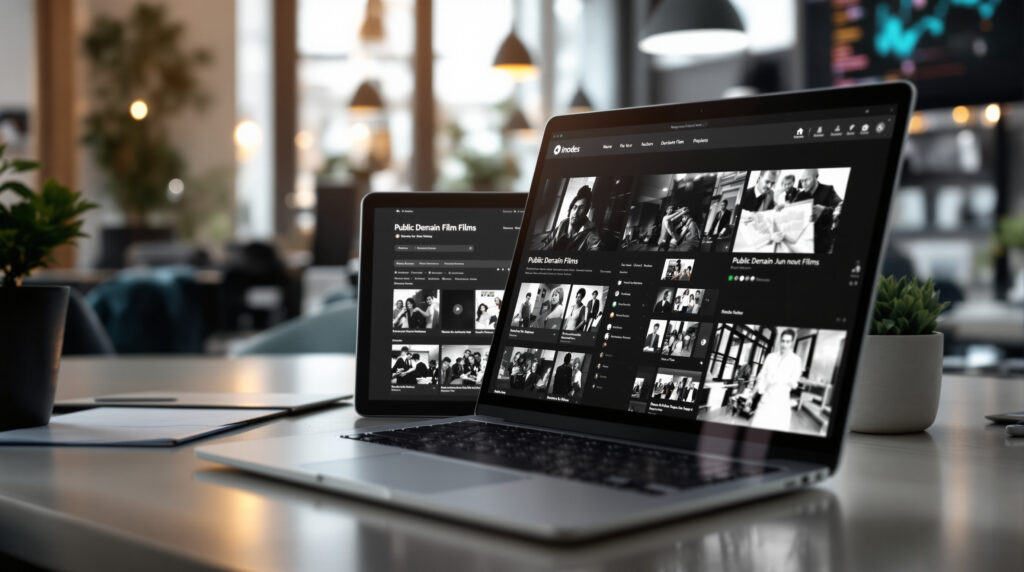
Wikiflix: What It Really Is
The name is misleading. Wikiflix sounds like a streaming service, but it isn’t a video platform in the traditional sense. It is a web interface hosted on Wikimedia Toolforge, the technical environment operated by the Wikimedia Foundation in the United States for community tools.
Specifically, Wikiflix queries Wikidata—the structured database of the Wikimedia ecosystem—and then displays the available movies along with an associated video. The files are not stored by Wikiflix; they come from Wikimedia Commons, the Internet Archive, or YouTube. This distinction makes all the difference from a legal, technical, and financial standpoint.
Another point to clarify: Wikiflix is not an officially approved Wikimedia sister project, like Wikipedia or Wikidata. A proposal for a sister project did exist on Meta-Wiki in 2022, but its status there is listed as “rejected” on July 7, 2022. The tool itself does exist and remains accessible at wikiflix.toolforge.org.
Why Wikiflix Is Free and Legal
Wikiflix’s free access is rooted in its scope: the site features works in the public domain or under open licenses. The public domain means that economic rights have expired, according to applicable rules, and that a work can be distributed more freely. This is not a gray area of streaming.
The examples often cited speak for themselves: A Trip to the Moon by Georges Méliès, sorti in 1902, Nosferatu in 1922, The Kid in 1921, The Gold Rush in 1925, Metropolis in 1927 or encore Night of the Living Dead in 1968. Many of the titles are from silent films, classic films, or cultural archives.
In 2025 and 2026, the French and international press described Wikiflix as free, legal, ad-free, and requiring no user account. The figures vary depending on the dates and sources: some articles mention more than 4,000 or 4,200 movies, while Geekzone reported 2,500 movies on January 21, 2026. This variation is normal, as the data comes from Wikidata and is updated automatically, with criteria that may change.
The pitfall for a non-technical person would be to believe that “free and legal” means “freely usable in all commercial contexts.” Before using a film in a corporate communication, an app, or a paid event, you must verify the exact license, the country in question, and sometimes the rights related to the music, subtitles, or image restoration.
Catalog, Video Quality, and User Experience
Wikidata stated on its help page that it had more than 33,000 items related to public-domain films, including approximately 1,300 with video files at the time this documentation was written. Wikiflix therefore does not immediately make the entire database available for viewing in movie theaters. Rather, it primarily makes visible what is already available for viewing.
The experience is still much rougher than that of an SVOD service. Video quality depends on the source files, which often come from archives. Some films are very clean, while others show their age: low resolution, inconsistent sound, incomplete versions, or intertitles in an unexpected language. Honestly, this is acceptable for discovering classics, but less so for organizing a high-end screening without checking the content beforehand.
The service also has a community-driven approach. A blacklist maintained by the community helps filter out films considered unsuitable for promotion on the homepage. This type of safeguard shows that a cultural platform is never just a matter of code: editorial guidelines are also necessary.
If your topic extends beyond independent film, drawing a comparison with other online video services helps put Wikiflix into context. For example, we analyzed documentary streaming alternatives, where the issue is not only the volume of content, but also its source, rights, and the trust placed in the service.
How It Works, Explained Simply
Wikiflix is based on a rather elegant idea: not to recreate an entire platform when the building blocks already exist. The metadata comes from Wikidata. The videos remain on the archive platforms. The interface serves as a search engine, a showcase, and a player.
The technical maintainer listed on Wikidata is Magnus Manske, a well-known figure in the Wikimedia ecosystem. The shared GitHub repository, magnusmanske/wikistream, is licensed under the GPL-3.0 and is used by both Wikiflix and WikiVibes. As of the 2026 snapshot, GitHub showed 172 commits, 17 stars, 2 forks, and 7 open issues: this is not a massive commercial product, but a vibrant open-source tool.
This architecture has very concrete consequences. Hosting costs remain low compared to a platform that would store and stream thousands of video files on its own. On the other hand, there is a high degree of dependence on external sources: if a file is moved, poorly indexed, or of poor quality, the interface cannot play it.
In the projects we undertake, we often see the same mistake: trying to build a complete proprietary platform too quickly, when an initial version could aggregate existing content, APIs (interfaces connecting software), and databases. Given the same budget, it’s sometimes better to invest in research, moderation, and user experience rather than in an overly ambitious video infrastructure.
What Wikiflix Teaches a Small Business Preparing to Launch a Platform
For a business leader, Wikiflix isn’t just a nice website for rewatching classics. It’s an example of a digital product that avoids three major costs: large-scale content acquisition, video storage, and user account management. Less complexity means less risk exposure.
Be aware, however, that this model isn’t suitable for everything. If you need to ensure consistent video quality, global rights, accurate per-user statistics, personalized recommendations, or payment processing, the architecture must be more robust. We’re moving from a cultural aggregator to a business platform.
| Platform Model or | Current launch costs in France | Realistic timeline | Point of vigilance |
|---|---|---|---|
| Wikiflix-style aggregation interface, no account required | around 8,000 to 25,000 €, depending on the source and the user experience (UX) | 4 to 8 weeks | data quality, rights, reliance on sources |
| Publishing platform with accounts and favorites | approximately €25,000 to €60,000 | 2 to 4 months | GDPR 2016/679, security, hosting, support |
| Video service with hosting, payment processing, and back-office functionality | often between €60,000 and €150,000 or more | 4 to 9 months | bandwidth, encoding, possible DRM, rights |
These amounts are typical estimates for the French market, not universal rates. A very basic prototype may cost less. An international, multilingual platform with advanced payment and moderation features will cost more.
The choice between a website, a PWA (installable web app), or a native app often comes up in this type of discussion. For a viewing interface, a well-designed website is often sufficient; our comparison between a mobile app and a website outlines the trade-offs between budget, visibility, and maintenance. If your primary use case is mobile but you want to avoid STores, a PWA might be a reasonable option.
Data, Rights, and Security: The Limits You Must Not Ignore
The first risk is legal. The public domain varies by country, particularly because terms of protection are not the same everywhere. In France, the general rule is 70 years after the author’s death, with some exceptions. In the United States, the historical rules are different. An international service must therefore document its decisions.
The second risk concerns the data. Wikiflix relies on Wikidata, whose richness comes from open contributions. This is an asset, but also a source of inconsistencies: multiple titles, languages, dates, file links, and categories. A professional platform must include checks, manual corrections, and a history of changes.
From the agency’s perspective, the standard practice is to separate three layers very early on: raw data, editorial validation, and public display. This separation prevents a catalog error from immediately becoming visible to users. It also facilitates audits, particularly when the project must comply with the GDPR or internal compliance requirements.
- Check the license for each piece of sensitive content, not just the overall status of the source site.
- Have a system in place to quickly resolve the issue if a beneficiary reports a problem.
- Measure reliance on external hosting services such as YouTube, the Internet Archive, or Wikimedia Commons.
- Document automatic updates, especially if they modify publicly visible content.
- Test mobile performance, because a comprehensive catalog can slow down if the pages are too large.
Performance is no small matter. A lightweight interface—with no registration required and no ads—can be very reliable as long as it remains fast. Best practices foreco-friendly web design These factors align with user interests: fewer scripts, cleaner pages, and a smoother display on mobile devices.
Should you take inspiration from Wikiflix for your own project?
Yes, if your project is based on discovery, cultural mediation, archiving, monitoring, or a catalog already available elsewhere. The aggregation model allows you to quickly test a value proposition without having to fund the entire technical infrastructure right away. This is often the right level of ambition for an MVP—that is, a first version that is useful but limited.
No, not if your promise is based on a premium experience that’s controlled from start to finish. In that case, video, rights, support, security, and audience analytics must be treated as core components. The obvious solution—copying Wikiflix—may actually be the wrong one: it reduces costs initially but creates too much uncertainty for a paid service.
One final lesson is worth noting: Wikiflix demonstrates the power of a clear interface built on open data. Many digital projects fail not so much because of a lack of technology as because they have too many features at launch. The right approach is often to make the user experience simple, verifiable, and fast before adding more costly layers.
Defining the scope of this type of project early on helps avoid most unpleasant surprises: rights, hosting, performance, maintenance, and actual budget. This is often where an outside perspective saves time, by distinguishing between what needs to be developed and what can be intelligently assembled.
Wikiflix FAQ
Is Wikiflix really legal in France?
Wikiflix features films in the public domain or under a free license, which makes its use legal in this context. For professional or commercial use, however, be sure to check the specific license for the film and the associated rights.
Do I need to create an account to watch movies on Wikiflix?
No. Available sources describe Wikiflix as accessible without registration, without a user account, and without payment.
Why does the quality of movies vary so much?
Wikiflix does not re-encode all movies into a single standard. The videos come from archives such as Wikimedia Commons, the Internet Archive, or YouTube, and the file qualities vary.
Does Wikiflix officially belong to Wikimedia?
No, Wikiflix is not an approved sister project of Wikimedia. It is hosted on Wikimedia Toolforge and relies on Wikidata, but the proposal for a sister project was rejected on Meta-Wiki in 2022.
Is it possible to create a platform like Wikiflix for your company?
Yes, provided that the content, rights, and data sources are properly defined. An initial version of an aggregator can be developed relatively quickly, but a full-fledged video platform requires a much larger budget and more robust governance.