
AI internal linking consists of organizing your internal links to help Google, Bing, and AI-enhanced search engines understand which pages matter, what they are about, and how they complement one another. For an SMB, the stakes are concrete: fewer invisible pages, better distribution of SEO autority, and less risk that useful content remains isolated at the very moment AI answers cite sources.
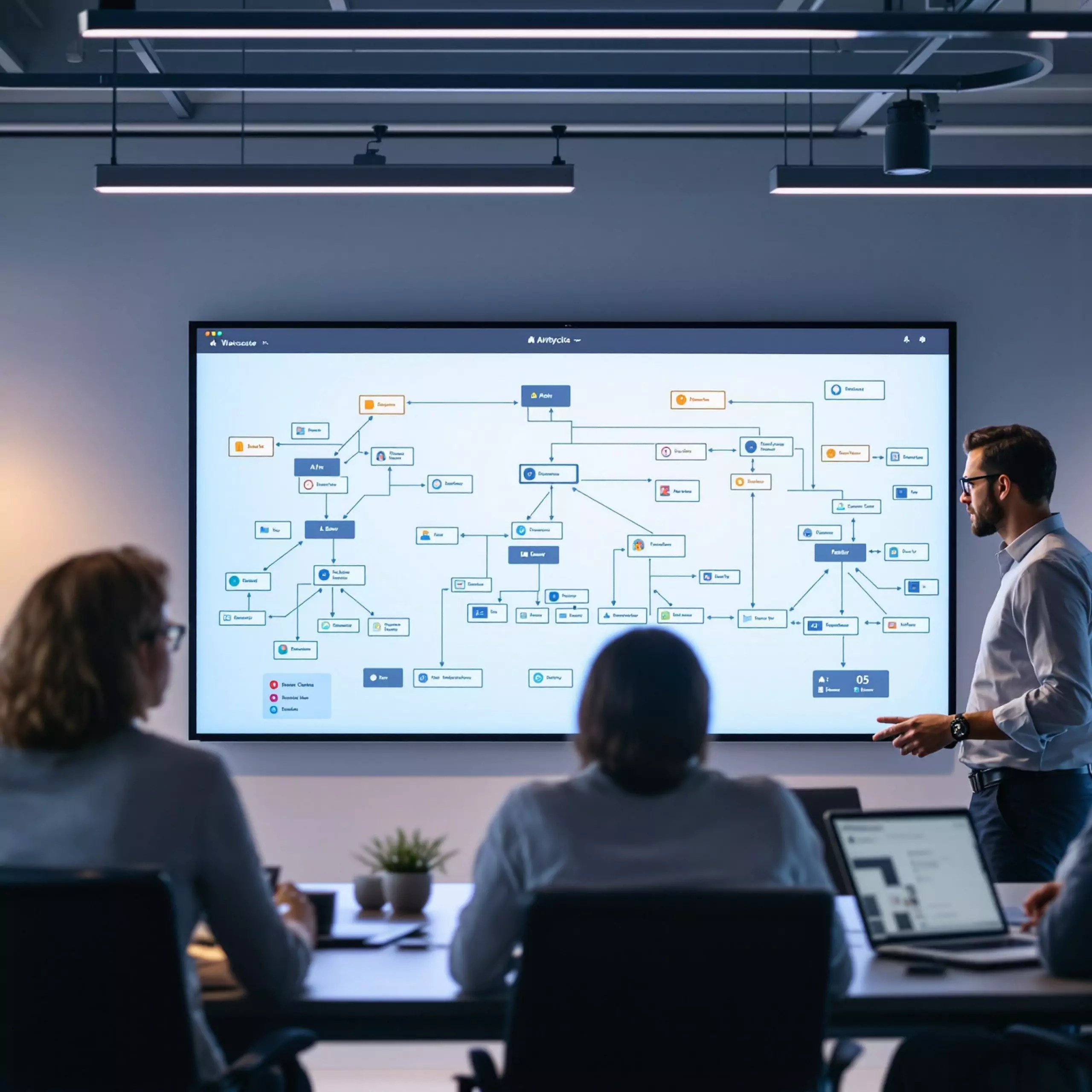
AI internal linking: what really changes for your site
An internal link is a link that connects two pages on the same site. Google Search Central still reminds us in 2025/2026 that these links are used to discover pages, crawl them with its bots, and then understand their relevance through the clickable text, called anchor text.
What is new is not that links are becoming useful. They already were. What changes with intelligent engines is their need to reconstruct context: which page is the reference, which page provides an example, which page answers a related question, and which page deserves to be cited.
Since May 2024, Google has been rolling out AI Overviews, responses generated with a Gemini model adapted for Search. Google indicated that these responses should link back to support pages, then corrected certain behaviors after inaccurate or strange results were reported in late May 2024. In other words, source citation remains a moving target, but your site’s structure matters more.
An expert page that is lost three clicks deep, with no link from a strong page, starts at a disadvantage. With the same budget, it is often better to improve the editorial architecture of an existing site than to publish ten new articles that never connect with one another.
Why AI engines read your site like a graph
A site is not just a collection of URLs. For a search engine, it is a graph: pages connected to one another by directed links. A page A points to a page B, and that action sends a signal of relationship, priority, and sometimes specialization.
This logic is longstanding in SEO, with concepts like PageRank, which measures the authority passed through links. It becomes more refined with AI, because systems also analyze the meaning of content. Embeddings, for example, are numerical representations of a text’s meaning; they make it possible to bring together two pages that discuss the same topic, even if they do not use exactly the same words.
The WebKnoGraph paper published in June 2026 illustrates this evolution well. It proposes an open source framework that models a site as a directed graph, represents pages with embeddings, and evaluates candidate internal links with GraphSAGE, a graph learning method. It is not a magic tool for SMBs, but the idea is useful: a good internal link must be both strategic and semantically coherent.
In the projects we work on, we often see the opposite mistake: links added because a tool suggests them, without checking whether the reader understands the transition from one page to another. The result may pass authority, but blur the user journey. And a blurred journey rarely ends in a conversion.
Solid rules before promises of automation
Before talking about AI, you need to follow the basics that Google and Bing document clearly. Important links must be crawlable, so they must be present in an HTML tag <a href="/en/.../">. A JavaScript button that triggers navigation without a readable link may look elegant visually, but it is less reliable for craworing.
The anchor should also describe the destination. “Click here” says nothing. “WordPress redesign checklist without losing your SEO” helps both the reader and the engine anticipate the content of the linked page. Google specifies that every important page should receive at least one internal link from another page on the site.
For an SMB, the practical rules come down to a few trade-offs:
- Link each strategic page from at least one page that is already visible or close to the menu.
- Avoid vague anchors and prefer natural wording that is close to user intent.
- Limit mass automatic links in the body of the text, especially if they always repeat the same anchors.
- Monitor orphan pages, that is, pages accessible via their URL but not linked to the rest of the site.
- Keep the structure up to date when the offering changes, as also recommended by Bing Webmaster Guidelines.
If your WordPress site is already several years old, an internal linking audit complements a WordPress redesign prepared without SEO loss. It is often at that moment that you discover pages that are stor generating leads, but that no internal link supports anymore.
AI, ChatGPT Search, and bots: beware of bad shortcuts
Search engines are no longer limited to Googlebot. OpenAI documentation distinguishes, for example, OAI-SearchBot, used to make sites appear in ChatGPT search features, and GPTBot, related to the training of generative models. The robots.txt rules are separate for each one.
The trap for a non-technical business owner: blocking AI bots too broadly thinking they are protecting their content, then being surprised not to appear in certain conversational search responses. According to OpenAI 2025/2026 documentation, sites that refuse OAI-SearchBot will not be displayed in ChatGPT Search responses, even though they may still appear as navigation links.
This does not mean opening everything to everyone. GDPR, customer areas, paid content, or sensitive data require clear rules. But for public pages that support your acquisition, the decision must be made consciously, with a robots.txt file that has been reviewed, not copied from a template found at random.
This broader reflection also ties into how companies use AI on their website. To frame uses without confusing automation with editorial management, the topic is close to website optimization through artificial intelligence.
How much does good AI-assisted internal linking cost?
Rates vary depending on the size of the site, the state of the content, and the level of analysis requested. In France, for a small business showcase or editorial site, a serious internal linking audit is often around €800 to €2,500 before tax. For a site with several hundred pages, with crawl, mapping, prioritization, and editorial support, budgets are more often in the €3,000 to €8,000 before tax range depending on the provider.
The timeline is more predictable. Allow one to two weeks for a site of 30 to 80 pages, and three to six weeks for a content-rich or multilingual site. Integrating the links sometimes takes more time than the audit, especially if each page must be reviewed to avoid artificial links.
| Approach | Estimated budget France | Typical timeframe | Main risk |
|---|---|---|---|
| Targeted manual audit, 30 to 80 pages | €800 to €2,500 before tax | 1 to 2 weeks | Missing opportunities on large volumes |
| SEO crawl + editorial recommendations | €1,500 to €5,000 before tax | 2 to 4 weeks | Produce non-integrated recommendations |
| AI assistance with human validation | 3,000 to 8,000 € excl. tax | 3 to 6 weeks | Accept links that are coherent for the tool, not for the reader |
| Massive automation without review | Variable, sometimes low | A few days | Repetitive anchors, dilution, confusing user journey |
Honestly, AI is only justified if the volume requires it or if the site has real depth. For a fifteen-page site, a good architecture, clean anchors, and a few well-placed contextual links are more than enough.
Priorize the pages that deserve to be understood
Not all pages should receive the same level of attention. A “legal notice” page should be accessible, but it is not intended to capture internal autority. By contrast, a service page, a guide page, or a case study may deserve several links from related content.
AI internal linking becomes interesting when it helps identify weak but useful pages: those that have good content, few incoming internal links, and commercial potential. The 2026 WebKnoGraph paper also remords us that automatic selection generally redistributes autority better, but at the cost of more fragile semantic coherence. Expert-assisted selection would preserve this coherence better, especially when targeting low-PageRank pages.
Typical case: a page on LocalBusiness structured data, useful for a local SME, can be linked from SEO content, website creation content, and local strategy content. In that case, a link to structured data for SMEs makes sense because it complements the reader’s intent, not because a quota has to be filled.
Another trade-off: if two pages target the same query, linking them is not enough. Sometimes they need to be merged, rewritten, or repositioned. Internal linking can reveal a problem of SEO cannibalization between competing pages, but it does not always corect it on its own.
Measure the effect on Google, Bing, and AI answers
Measurement remains imperfect. Google Search Console allows you to track impressions, clicks, and queries by page, but does not provide a complete view of citations in AI Overviews. An arXiv study published on May 13, 2026, conducted on 55,393 trending queries between March and April 2026, measured AI Overviews activation at 13.7 % overall and 64.7 % for queries formulated as questions.
The same study observed 7,583 AI Overviews citing 61,212 reference URLs, with a median of 8 references per answer. It also remords us that nearly 30 % of the cited domains did not appear in the first-page organic results displayed alongside them. Caution: this is a study, not an official rule, but it confirms that AI visibility does not always mirror traditional SEO rankings.
In concrete terms, track three families of indicators: orphan pages, click depth from the homepage, and performance of strategic pages after adding links. Tools like Screaming Frog SEO Spider, Sitebulb, Ahrefs, or Semrush help map these signals. On the technical side, performance remains tied to crawlability: slow, heavy, or poorly rendered pages complicate exploration, hence the value of also addressing topics like choosing between WebP and AVIF to speed up a site.
Defining this type of project upfront avoids most unpleasant surprises: priority pages, robots rules, anchors, integration budget, editorial responsibilities. This is often where an outside perspective saves time, especially when the site has already been around for several years of historory.
FAQ on AI internal linking
Does AI internal linking replace an SEO consultant?
No. AI can suggest links and identify semantic relationships, but it does not always understand your business strategy, your margins, or your prior conversion priorities. Human validation remains necessary.
How many internal links should be included on a page?
There is no universal number. On a 1,000-word page, a few useful contextual links are better than a dozen weak links. The right criterion remains the help apportée to the reader.
Are exact match anchors dangerous for SEO?
Internally, descriptive anchor text is recommended by Google, but repeating it mechanically can seem artificial. Vary the formulations while remaining clear about the destination page.
Can a site that blocks AI robots still be visible on Google?
Yes, depending on the blocked bots and the rules used. But blocking certain AI search bots, such as OAI-SearchBot from OpenAI, may prevent display in ChatGPT Search responses.