
Des champs de bataille du XXe siècle à la guerre connectée
Au début du XXe siècle, le casque militaire n’était qu’un symbole de survie.
Des modèles emblématiques comme le casque Adrian français (1915) ou le M1 américain (1941) offraient une protection basique contre les éclats et les débris, souvent fabriqués en acier lourd.
Leur mission : encaisser, pas réfléchir.
Mais avec la modernisation des conflits, la simple coque métallique a laissé place à une question plus complexe : comment protéger, sans isoler ?
Les années 1980–2000 : l’ère du Kevlar et de la standardisation
L’introduction du Kevlar a été une révolution. Avec le PASGT (Personnel Armor System for Ground Troops), l’armée américaine inaugure une nouvelle génération de casques légers et résistants aux balles. Le design devient plus ergonomique, la visière descend, la nuque se couvre.
Puis vient le MICH (Modular Integrated Communications Helmet) — premier casque pensé non seulement pour la protection, mais pour l’intégration : micros, systèmes radio, montures NVG. La guerre change — le casque aussi. On passe du simple “bouclier” à la première brique du soldat moderne interconnecté.
La décennie 2010 : naissance du concept FAST
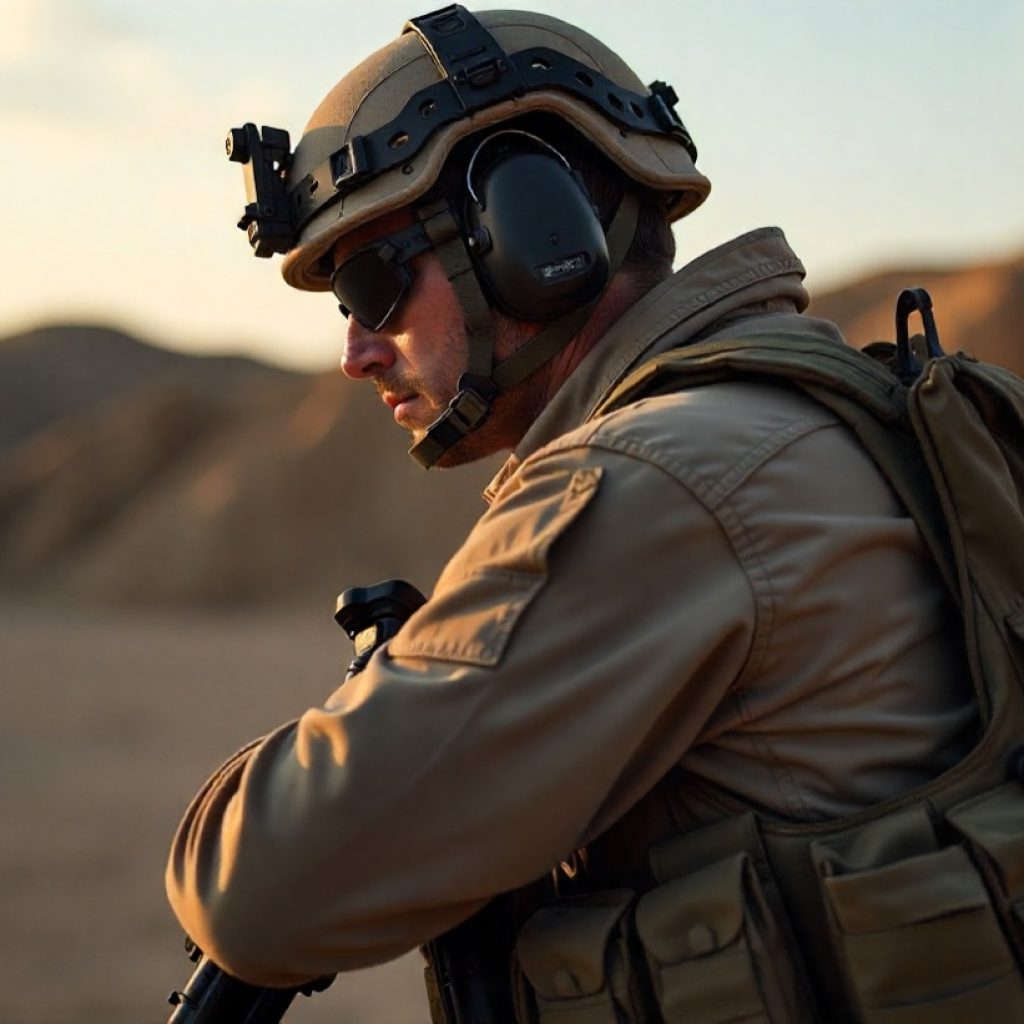
Quand Ops-Core introduit son FAST (Future Assault Shell Technology), le paradigme du casque tactique militaire bascule. Le casque ne se limite plus à protéger — il devient modulaire, un véritable hub tactique capable d’intégrer communications, vision nocturne et accessoires. Son profil plus haut, ses rails latéraux, et sa structure en polyéthylène ultra-haute densité (UHMWPE) associée à des fibres aramides composites permettent de réduire le poids jusqu’à 30 %, sans aucun compromis sur la protection balistique.
Chaque élément est pensé pour recevoir autre chose : lampes, caméras, systèmes audio comme 3M Peltor ComTac ou Earmor M32H, fixations NVG pour vision nocturne, contrepoids, batteries externes.
Le casque devient intelligent, interactif, prêt à évoluer au rythme de la mission.
Une nouvelle philosophie du confort et de la perception
L’un des grands défis des concepteurs modernes n’est plus la résistance, mais l’endurance.
Un casque de nouvelle génération ne doit pas simplement arrêter un impact — il doit permettre à l’opérateur de rester concentré pendant 10 heures, sous chaleur, bruit et stress.
Les modèles actuels — Team Wendy EXFIL, OPS-CORE FAST SF, Earmor Helmet System — misent sur des liners thermorégulants, des systèmes de réglage BOA, et une isolation acoustique active intégrée. L’idée : une bulle de performance où chaque sens reste opérationnel.
En 2025, un casque tactique ne se limite plus à sa coque.
Il dialogue avec le reste de l’équipement :
les lunettes balistiques communiquent avec les écrans tête haute,
les headsets actifs amplifient ou filtrent les sons selon le contexte,
et les capteurs internes peuvent analyser la température ou l’impact pour détecter une commotion.
La frontière entre protection et technologie s’efface — le casque devient une interface, un cerveau périphérique.
Les recherches actuelles s’orientent vers des casques encore plus légers, imprimés en 3D composite, intégrant des circuits de réalité augmentée et des capteurs biométriques. L’objectif ? Transformer le casque en véritable outil d’analyse : mesurer la fatigue, la fréquence cardiaque, la désorientation, et envoyer ces données en temps réel au commandement.
Ce n’est plus seulement un équipement défensif — c’est un système d’information personnel.
En un siècle, le casque tactique est passé du simple dôme d’acier au centre nerveux du soldat moderne. Son évolution raconte celle de la guerre elle-même : plus rapide, plus technologique, plus connectée. Là où hier on protégeait la tête, aujourd’hui on protège la conscience, la perception et la coordination.